

Valid CCNP Enterprise 300-440 Dumps Ensure Your Passing
300-440 Dumps Real Exam Questions Test Engine Dumps Training
Cisco 300-440 Exam Syllabus Topics:
| Topic | Details |
|---|---|
| Topic 1 |
|
| Topic 2 |
|
| Topic 3 |
|
| Topic 4 |
|
| Topic 5 |
|
NEW QUESTION # 19 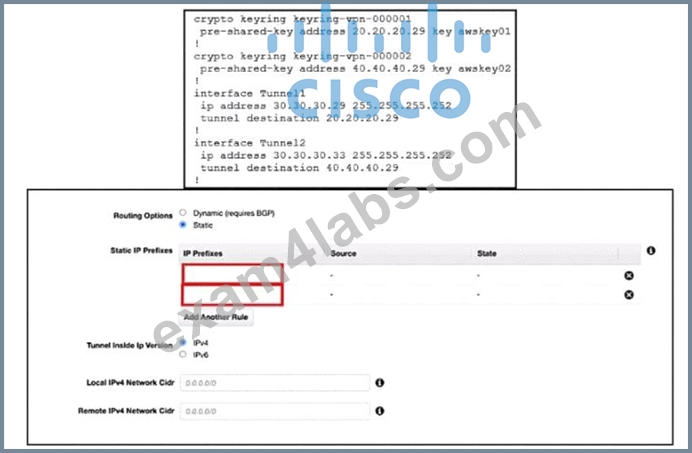
Refer to the exhibits. An engineer needs to configure a site-to-site IPsec VPN connection between an on premises Cisco IOS XE router and Amazon Web Services (AWS). Which two IP prefixes should be used to configure the AWS routing options? (Choose two.)
- A. 30.30.30.0/30
- B. 40.40.40.0/24
- C. 20.20.20.0/24
- D. 50.50.50.0/30
- E. 30.30.30.0/24
Answer: A,B
Explanation:
The correct answer is A and E because they are the IP prefixes that match the tunnel interfaces on the Cisco IOS XE router. The AWS routing options should include the local and remote IP prefixes that are used for the IPsec tunnel endpoints. The other options are either the public IP addresses of the routers or the LAN subnets that are not relevant for the IPsec tunnel configuration. References := Designing and Implementing Cloud Connectivity (ENCC) v1.0, Configure IOS-XE Site-to-Site VPN Connection to Amazon Web Services, Site-to-Site VPN with Amazon Web Services
NEW QUESTION # 20
An engineer is implementing a highly securemultitierapplication in AWS that includes S3. RDS, and some additional private links. What is critical to keep the traffic safe?
- A. specific routing and bucket policies
- B. gateway load balancers and specific routing policies
- C. VPC peering and bucket policies
- D. EC2 super policies and specific routing policies
Answer: A
Explanation:
A highly secure multitier application in AWS that includes S3, RDS, and some additional private links requires specific routing and bucket policies to keep the traffic safe. The reasons are as follows:
Specific routing policies are needed to ensure that the traffic between the tiers is routed through the private links, which provide secure and low-latency connectivity between AWS services and on-premises resources12. The private links can also prevent the exposure of the data and the application logic to the public internet12.
Bucket policies are needed to control the access to the S3 buckets that store the application data34. Bucket policies can specify the conditions under which the requests are allowed or denied, such as the source IP address, the encryption status, the request time, etc.34. Bucket policies can also enforce encryption in transit and at rest for the data in S334.
References :=
1: AWS PrivateLink
2: AWS PrivateLink FAQs
3: Using Bucket Policies and User Policies
4: Bucket Policy Examples
NEW QUESTION # 21
What is the role of service providers to establish private connectivity between on-premises networks and Google Cloud resources?
- A. enable intelligent routing and dynamic path selection using software-defined networking
- B. facilitate direct, dedicated network connections through Google Cloud Interconnect
- C. provide end-to-end encryption for data transmission using native IPsec
- D. accelerate content delivery through integration with Google Cloud CDN
Answer: B
Explanation:
The role of service providers to establish private connectivity between on-premises networks and Google Cloud resources is to facilitate direct, dedicated network connections through Google Cloud Interconnect.
Google Cloud Interconnect is a service that allows customers to connect their on-premises networks to Google Cloud through a service provider partner. This provides low latency, high bandwidth, and secure connectivity to Google Cloud services, such as Google Compute Engine, Google Cloud Storage, and Google BigQuery.
Google Cloud Interconnect also supports hybrid cloud scenarios, such as extending on-premises networks to Google Cloud regions, or connecting multiple Google Cloud regions together. Google Cloud Interconnect offers two types of connections: Dedicated Interconnect and Partner Interconnect. Dedicated Interconnect provides physical connections between the customer's network and Google's network at a Google Cloud Interconnect location. Partner Interconnect provides virtual connections between the customer's network and Google's network through a supported service provider partner. Both types of connections use VLAN attachments to establish private connectivity to Google Cloud Virtual Private Cloud (VPC) networks. References:
Designing and Implementing Cloud Connectivity (ENCC) v1.0
[Google Cloud Interconnect Overview]
[Google Cloud Interconnect Documentation]
NEW QUESTION # 22
Refer to the exhibit.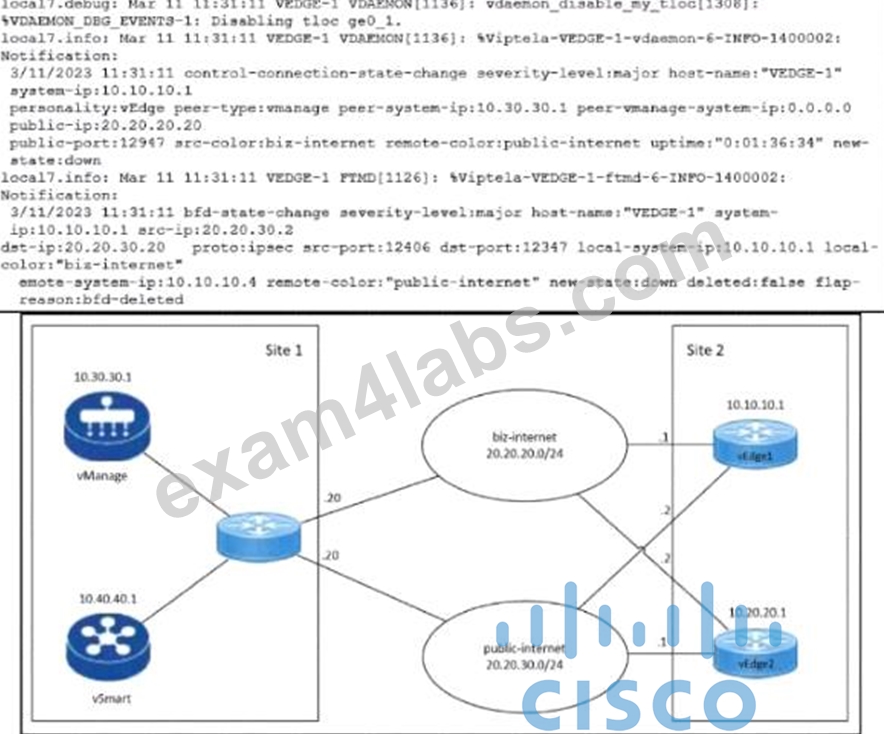
Refer to the exhibits. An engineer troubleshoots a Cisco SD-WAN connectivity issue between an on-premises data center WAN Edge and a public cloud provider WAN Edge. The engineer discovers that BFD is Dapping on vEdge1. What is the problem?
- A. The control plane deleted the BFD session.
- B. The remote Edge device has a duplicate IP address.
- C. The remote Edgedevice failed to respond BFD keepalives.
- D. The remote Edge device BFD is down.
Answer: C
Explanation:
BFD (Bidirectional Forwarding Detection) is a protocol that detects failures in the overlay tunnel between Cisco SD-WAN devices. BFD packets are sent and received periodically by each device to check the liveliness and quality of the connection. If a device does not receive a BFD packet from its peer within a specified timeout interval, itconsiders the peer to be unreachable and reports a BFD down event. This event triggers a control connection state change and a possible route change in the SD-WAN fabric.
In this scenario, the engineer discovers that BFD is flapping on vEdge1, which means that the BFD session between vEdge1 and the remote Edge device is going up and down repeatedly. This indicates a connectivity issue between the two devices, such as network congestion, packet loss, or misconfiguration. The most likely cause of the problem is that the remote Edge device failed to respond BFD keepalives within the timeout interval, which resulted in a BFD timeout event on vEdge1. This event caused vEdge1 to mark the remote Edge device as down and notify the control plane. The control plane then tried to establish a new BFD session with the remote Edge device, which may have succeeded or failed depending on the network condition. This cycle of BFD session creation and deletion caused the BFD flapping on vEdge1.
The other options are less likely to be the cause of the problem. Option A is incorrect because if the remote Edge device BFD was down, vEdge1 would not receive any BFD packets from it and would not flap. Option C is incorrect because if the remote Edge device had a duplicate IP address, vEdge1 would not be able to establish a BFD session with it in the first place. Option D is incorrect because the control plane does not delete the BFD session unless there is a configuration change or a port-hop event on the device. References: Bidirectional Forwarding Detection Flap-Reason Definitions on Cisco vEdge Routers, Cisco Catalyst SD-WAN BFD, Cisco SD WAN: BFD (Bidirectional Forwarding Detection)
NEW QUESTION # 23 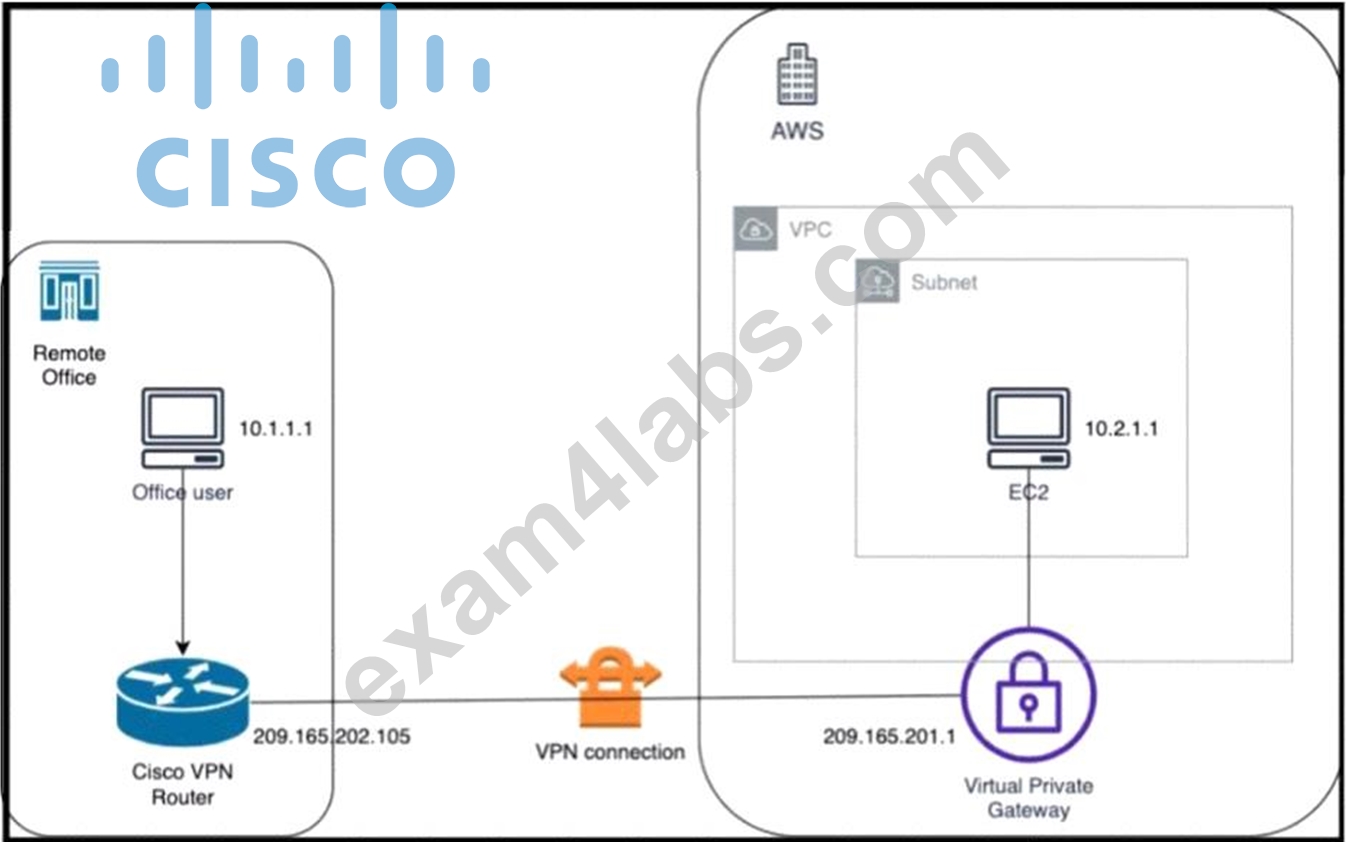
Refer to the exhibit. An engineer successfully brings up the site-to-site VPN tunnel between the remote office and the AWS virtual private gateway, and the site-to-site routing works correctly. However, the end-to-end ping between the office user PC and the AWS EC2 instance is not working. Which two actions diagnose the loss of connectivity? (Choose two.)
- A. Check the IPsec SA counters.
- B. On the Cisco VPN router, configure the IPsec SA to allow ping packets.
- C. Check the network security group rules on the host VNET.
- D. On the AWS private virtual gateway, configure the IPsec SA to allow ping packets.
- E. Check the security group rules for the host VPC.
Answer: A,E
Explanation:
The end-to-end ping between the office user PC and the AWS EC2 instance is not working because either the security group rules for the host VPC are blocking the ICMP traffic or the IPsec SA counters are showing errors or drops. To diagnose the loss of connectivity, the engineer should check both the security group rules and the IPsec SA counters. The network security group rules on the host VNET are not relevant because they apply to Azure, not AWS. The IPsec SA configuration on the Cisco VPN router and the AWS private virtual gateway are not likely to be the cause of the problem because the site-to-site VPN tunnel is already up and the site-to-site routing works correctly. References := Designing and Implementing Cloud Connectivity (ENCC, Track 1 of 5), Module 3: Configuring IPsec VPN from Cisco IOS XE to AWS, Lesson 3: Verify IPsec VPN Connectivity Security for VPNs with IPsec Configuration Guide, Cisco IOS XE, Chapter: IPsec VPN Overview, Section: IPsec Security Association AWS Documentation, User Guide for AWS VPN, Section: Security Groups for Your VPC
NEW QUESTION # 24
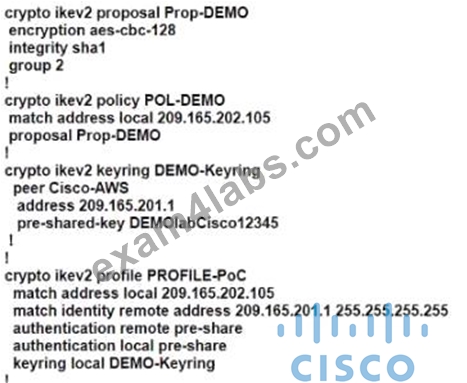
Refer to the exhibit.
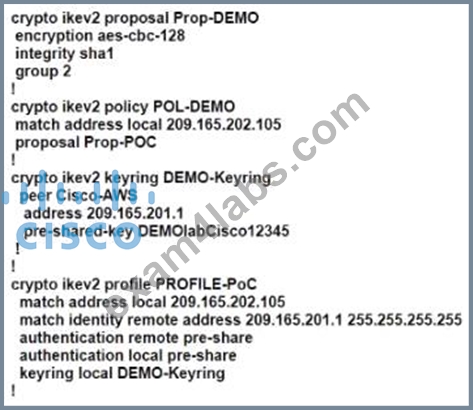
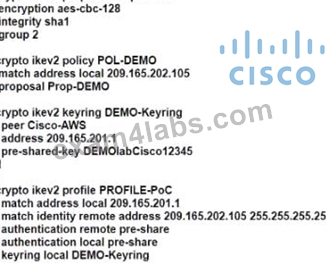
Which Cisco lKEv2 configuration brings up the IPsec tunnel between the remote office router and the AWS virtual private gateway?
- A.
- B.
- C.
Answer: C
Explanation:
Option C is the correct answer because it configures the IKEv2 profile with the correct match identity, authentication, and keyring parameters. It also configures the IPsecprofile with the correct transform set and lifetime parameters. Option A is incorrect because it does not specify the match identity remote address in the IKEv2 profile, which is required to match the AWS virtual private gateway IP address. Option B is incorrect because it does not specify the authentication pre-share in the IKEv2 profile, which is required to authenticate the IKEv2 peers using a pre-shared key. Option C also matches the configuration example provided by AWS1 and Cisco2 for setting up an IKEv2 IPsec site-to-site VPN between a Cisco IOS-XE router and an AWS virtual private gateway. References :=
1: AWS VPN Configuration Guide for Cisco IOS-XE
2: Configure IOS-XE Site-to-Site VPN Connection to Amazon Web Services
NEW QUESTION # 25
An engineer signs in to Cisco vManage and needs to configure a custom application with a Cisco SD-WAN centralized policy. Drag and drop the steps from the left onto the order on the right to complete the configuration.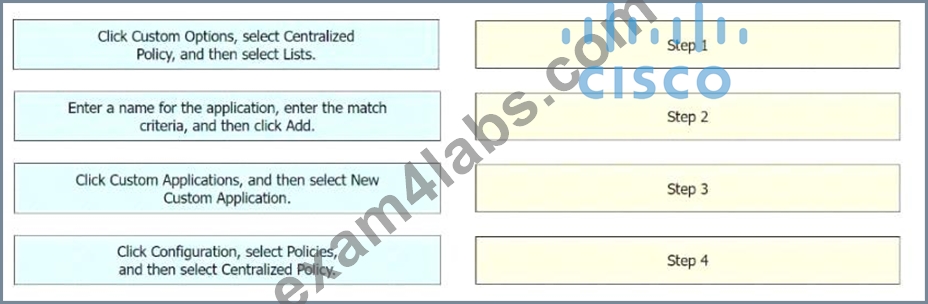
Answer:
Explanation: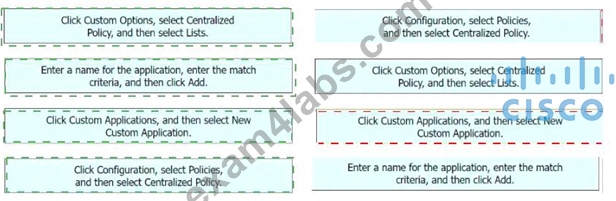
Explanation:
To configure a custom application with Cisco SD-WAN centralized policy, you need to follow these steps25:
Click Configuration, select Policies, and then select Centralized Policy.
Click Custom Options, select Centralized Policy, and then select Lists.
Click Custom Applications, and then select New Custom Application.
Enter a name for the application, enter the match criteria, and then click Add.
The process of configuring a custom application with a Cisco SD-WAN centralized policy using Cisco vManage involves several steps1.
Click Configuration, select Policies, and then select Centralized Policy: This is the first step where you navigate to the Policies section in the Configuration menu of Cisco vManage1.
Click Custom Options, select Centralized Policy, and then select Lists: In this step, you select the Custom Options, then select Centralized Policy, and finally select Lists1.
Click Custom Applications, and then select New Custom Application: After setting up the Lists, you click on Custom Applications and then select New Custom Application1.
Enter a name for the application, enter the match criteria, and then click Add: Finally, you enter a name for the application, specify the match criteria, and then click Add to complete the configuration1.
References :=
Cisco Catalyst SD-WAN Policies Configuration Guide, Cisco IOS XE
NEW QUESTION # 26
Which Microsoft Azure service enables a dedicated and secure connection between an on-premises infrastructure and Azure data centers through a colocation provider?
- A. Azure ExpressRoute
- B. Azure Private Link
- C. Azure Virtual Network
- D. Azure Site-to-Site VPN
Answer: A
Explanation:
Azure ExpressRoute is a service that enables a dedicated and secure connection between an on-premises infrastructure and Azure data centers through a colocation provider. A colocation provider is a third-party data center that offers network connectivity services to multiple customers. Azure ExpressRoute allows customers to bypass the public internet and connect directly to Azure services, such as virtual machines, storage, databases, and more. This provides benefits such as lower latency, higher bandwidth, more reliability, and enhanced security. Azure ExpressRoute also supports hybrid scenarios, such as connecting to Office 365, Dynamics 365, and other SaaS applications hosted on Azure. Azure ExpressRoute requires a physical connection between the customer's network and the colocation provider's network, as well as a logical connection between the customer's network and the Azure virtual network. The logical connection is established using a Border Gateway Protocol (BGP) session, which exchanges routing information between the two networks. Azure ExpressRoute supports two models: standard and premium. The standard model offers connectivity to all Azure regionswithin the same geopolitical region, while the premium model offers connectivity to all Azure regions globally, as well as additional features such as increased route limits, global reach, and Microsoft peering. References: Designing and Implementing Cloud Connectivity (ENCC) v1.0, Learning Plan: Designing and Implementing Cloud Connectivity v1.0 (ENCC 300-440) Exam Prep, ENCC | Designing and Implementing Cloud Connectivity | Netec
NEW QUESTION # 27 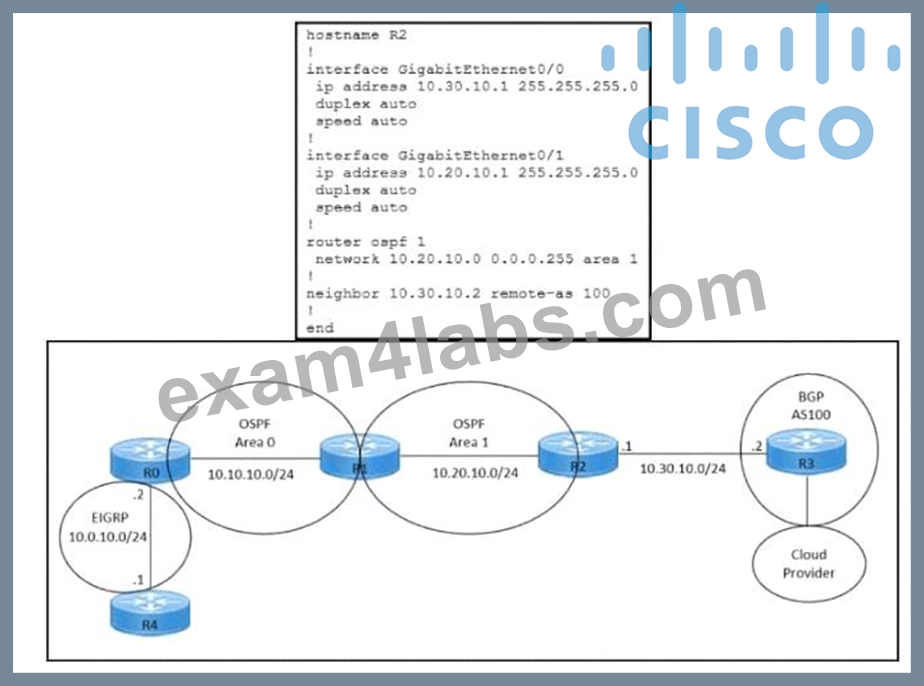
Refer to the exhibits. An engineer must redistribute OSPF internal routes into BGP to connect an on-premises network to a cloud provider without introducing extra routes. Which two commands must be configured on router R2? (Choose two.)
- A. redistribute ospf 1
- B. redistribute ospf 1 match internal external
- C. redistribute bgp 100
- D. router ospf 1
- E. router bgp 100
Answer: B,E
Explanation:
To redistribute OSPF internal routes into BGP, the engineer needs to configure two commands on router R2.
The first command is router bgp 100, which enables BGP routing process and specifies the autonomous system number of 100. The second command is redistribute ospf 1 match internal external, which redistributes the routes from OSPF process 1 into BGP, and matches both internal and external OSPF routes. This way, the engineer can avoid introducing extra routes that are not part of OSPF process 1, such as the default route or the connected routes. References: = Designing and Implementing Cloud Connectivity (ENCC) v1.0, [ENCC:
Configuring IPsec VPN from Cisco IOS XE to AWS], [Deploying Cisco IOS VTI-Based Point-to-Point IPsec VPNs]
NEW QUESTION # 28
An engineer must edit the settings of a site-to-site IPsec VPN connection between an on-premises Cisco IOS XE router and Amazon Web Services (AWS). IPsec must be configured to support multiple peers and failover after 120 seconds of idle time on the first entry of the crypto map named Cisco. Drag and drop the commands from the left onto the order on the right.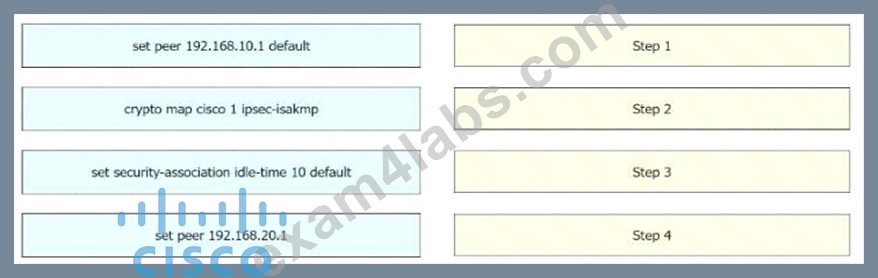
Answer:
Explanation: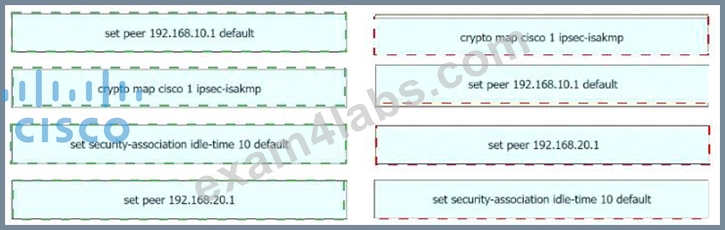
Explanation:
Step 1 = crypto map cisco 1 ipsec-isakmp Step 2 = set peer 192.168.10.1 default Step 3 = set peer
192.168.20.1 Step 4 = set security-association idle-time 120 default
The process of editing the settings of a site-to-site IPsec VPN connection between an on-premises Cisco IOS XE router and Amazon Web Services (AWS), and configuring IPsec to support multiple peers and failover after 120 seconds of idle time on the first entry of the crypto map named Cisco involves several steps123456.
crypto map cisco 1 ipsec-isakmp: This command is used to create a new entry in the crypto map named
"cisco". The "1" is the sequence number of the entry, and "ipsec-isakmp" specifies that the IPSec security associations (SAs) should be established using the Internet Key Exchange (IKE) protocol13.
set peer 192.168.10.1 default: This command is used to specify the IP address of the default peer for the crypto map entry. In this case, the default peer is at IP address 192.168.10.115.
set peer 192.168.20.1: This command is used to add an additional peer to the crypto map entry. In this case, the additional peer is at IP address 192.168.20.1. This allows the IPsec VPN to support multiple peers56.
set security-association idle-time 120 default: This command is used to set the idle time for the security association. If no traffic is detected over the VPN for the specified idle time (in this case, 120 seconds), the security association is deleted, and the VPN connection fails over to the next peer46.
References :=
Configure a Site-to-Site IPSec IKEv1 Tunnel Between an ASA and a Cisco IOS Router - Cisco Configure IOS-XE Site-to-Site VPN Connection to Amazon Web Services - Cisco Community Configuring Site to Site IPSec VPN Tunnel Between Cisco Routers Configure Failover for IPSec Site-to-Site Tunnels with Backup ISP Links on FTD Managed by FMC - Cisco Does Setting Multiple Peers in a Crypto Map Also Support Parallel IPSec Connections - Cisco Community Multiple WAN Connections - IPsec in Multi-WAN Environments | pfSense Documentation Multiple Set Peer for VPN Failover - Server Fault
NEW QUESTION # 29
A company with multiple branch offices wants a connectivity model to meet its network architecture requirements. The company focuses on ensuring low latency and efficient routing for its critical business applications. Which connectivity model meets these requirements?
- A. fully meshed topology with SD-WAN technology, using dynamic routing and BGP as the routing protocol
- B. point-to-point topology using dedicated leased lines and static routing
- C. hub-and-spoke topology with SD-WAN technology, using dynamic routing and OSPF as the routing protocol
- D. star topology with internet-based VPN connections and static routing
Answer: A
Explanation:
A fully meshed topology with SD-WAN technology, using dynamic routing and BGP as the routing protocol, meets the requirements of the company because it provides the following benefits:
It allows direct and secure connectivity between any two branch offices, without the need for a central hub or intermediary devices12. This reduces the latency and improves the performance of the critical business applications.
It leverages SD-WAN technology to optimize the traffic flow and application quality of service (QoS) across the WAN13. SD-WAN can dynamically select the best path for each application based on the network conditions and policies13. SD-WAN can also provide redundancy, security, and visibility for the WAN13.
It uses dynamic routing and BGP as the routing protocol to exchange routing information and establish connectivity between the branch offices14. BGP is a scalable and flexible protocol that can support multiple address families, such as IPv4 and IPv6, and multiple routing policies, such as local preference and route filtering14. BGP can also enable seamless integration with the cloud service providers (CSPs) and internet service providers (ISPs)14.
References :=
1: Designing and Implementing Cloud Connectivity (ENCC, Track 1 of 5) (Cisco U. login required)
2: Cisco SD-WAN Design Guide
NEW QUESTION # 30
Which architecture model establishes internet-based connectivity between on-premises networks and AWS cloud resources?
- A. That uses Amazon CloudFrontfor caching and distributing content globally and uses HTTPS for secure data transfer.
- B. That relies on AWS Elastic Load Balancing (ELB) for traffic distribution and uses SSL/TLS encryption for secure data transmission.
- C. That employs AWS Direct Connect for a dedicated network connection and uses private IP addresses tor secure communication.
- D. That establishes an iPsec VPN tunnel with Internet Key Exchange (IKE) for secure key negotiation and encrypted data transmission
Answer: D
Explanation:
The architecture model that establishes internet-based connectivity between on-premises networks and AWS cloud resources is the one that establishes an iPsec VPN tunnel with Internet Key Exchange (IKE) for secure key negotiation and encrypted data transmission. This model is also known as the VPN CloudHub model12. It allows multiple remote sites to connect to the same virtual private gateway in AWS, creating a hub-and-spoke topology1. The VPN CloudHub model provides the following benefits12:
It enables secure communication between remote sites and AWS over the public internet, using encryption and authentication protocols such as IPsec and IKE.
It supports dynamic routing protocols such as BGP, which can automatically adjust the routing tables based on the availability and performance of the VPN tunnels.
It allows for redundancy and load balancing across multiple VPN tunnels, increasing the reliability and throughput of the connectivity.
It simplifies the management and configuration of the VPN connections, as each remote site only needs to establish one VPN tunnel to the virtual private gateway in AWS, rather than multiple tunnels to different VPCs or regions.
The other options are not correct because they do not establish internet-based connectivity between on-premises networks and AWS cloud resources. Option B relies on AWS Elastic Load Balancing (ELB) for traffic distribution and uses SSL/TLS encryption for secure data transmission. However, ELB is a service that distributes incoming traffic across multiple targets within a VPC, not across different networks3. Option C employs AWS Direct Connect for a dedicated network connection and uses private IP addresses for secure communication. However, AWS Direct Connect is a service that establishes a private connection between on-premises networks and AWS, bypassing the public internet4. Option D uses Amazon CloudFront for caching and distributing content globally and uses HTTPS for secure data transfer. However, Amazon CloudFront is a service that delivers static and dynamic web content to end users, not to on-premises networks5.
References:
1: Designing and Implementing Cloud Connectivity (ENCC, Track 1 of 5)
2: Cisco ASA Site-to-Site VPN
3: What Is Elastic Load Balancing?
4: What is AWS Direct Connect?
NEW QUESTION # 31
An engineer must use Cisco vManage to configure an application-aware routing policy Drag and drop the steps from the left onto the order on the right to complete the configuration.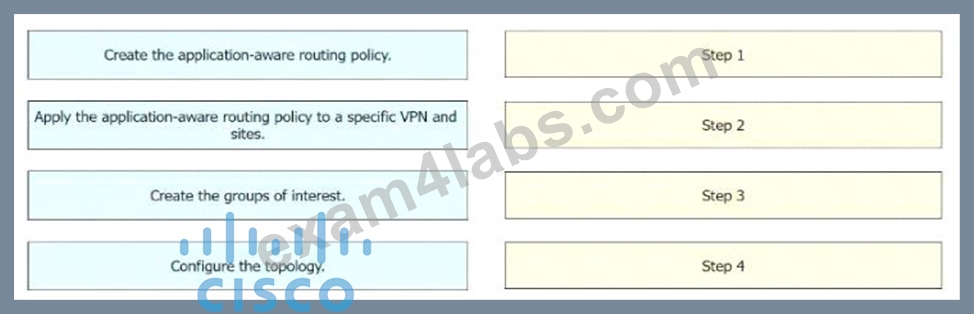
Answer:
Explanation: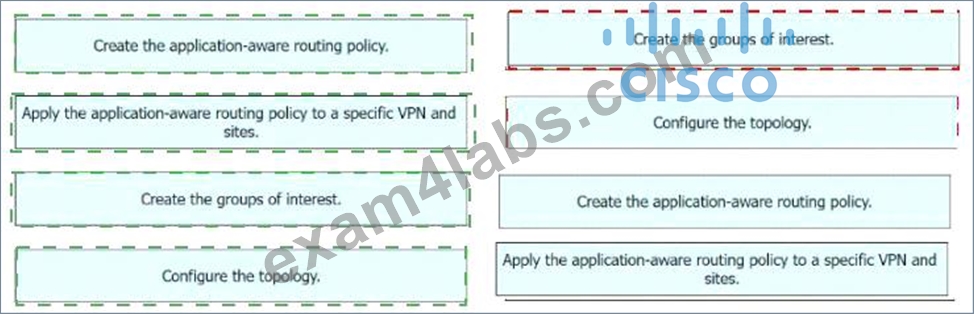
Explanation:
Step 1 = Create the groups of interest. Step 2 = Configure the topology. Step 3 = Create the application-aware routing policy. Step 4 = Apply the application-aware routing policy to a specific VPN and sites.
The process of configuring an application-aware routing policy in Cisco vManage involves several steps12.
Create the groups of interest: This is the first step where you define the applications or groups that the policy will affect1.
Configure the topology: This involves setting up the network topology that the policy will operate within1.
Create the application-aware routing policy: After setting up the groups and topology, you then create the application-aware routing policy. This policy tracks network and path characteristics of the data plane tunnels between Cisco SD-WAN devices and uses the collected information to compute optimal paths for data traffic31.
Apply the application-aware routing policy to a specific VPN and sites: Finally, the created policy is applied to a specific VPN and sites. This allows the policy to affect the desired network traffic1.
References :=
Designing and Implementing Cloud Connectivity (ENCC) v1.0
Learning Plan: Designing and Implementing Cloud Connectivity v1.0 (ENCC 300-440) Information About Application-Aware Routing - Cisco Configuring Application-Aware Routing (AAR) Policies | NetworkAcademy.io Policies Configuration Guide, Cisco IOS XE SD-WAN Releases 16.11, 16.12
NEW QUESTION # 32
An engineer must configure a CLI add-on feature template in Cisco vManage for enhanced policy-based routing (ePBR) for IPv4. These configurations were deleted:
* licensing config enable false
* licensing config privacy hostname true
* licensing config privacy version false
* licensing config utility utility-enable true
Drag and drop the steps from the left onto the order on the right to complete the configuration.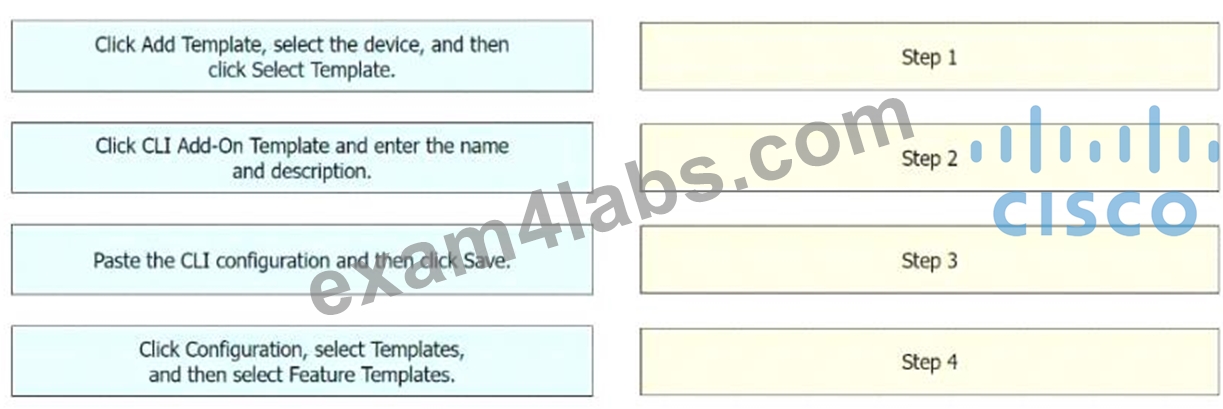
Answer:
Explanation: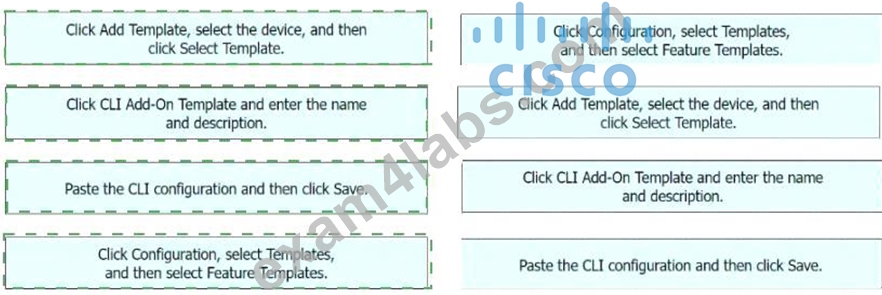
Explanation:
Step 1 = Click Configuration, select Templates, and then select Feature Templates. Step 2 = Click Add Template, select the device, and then click Select Template. Step 3 = Click CLI Add-On Template and enter the name and description. Step 4 = Paste the CLI configuration and then click Save.
The process of configuring a CLI add-on feature template in Cisco vManage for enhanced policy-based routing (ePBR) for IPv4 involves several steps1234.
Click Configuration, select Templates, and then select Feature Templates: This is the first step where you navigate to the Templates section in the Configuration menu of Cisco vManage1.
Click Add Template, select the device, and then click Select Template: In this step, you add a new template for the device1.
Click CLI Add-On Template and enter the name and description: After setting up the template, you select the CLI Add-On Template option, and then enter the name and description for the template1.
Paste the CLI configuration and then click Save: Finally, you paste the CLI configuration into the template and save the changes1.
References :=
CLI Add-On Feature Templates - Cisco
Cisco Catalyst SD-WAN Systems and Interfaces Configuration Guide, Cisco IOS XE Catalyst SD-WAN Release 17.x - CLI Add-On Feature Templates Cisco SD-WAN vSmart CLI Template - NetworkLessons.com CLI Templates for Cisco XE SD-WAN Routers
NEW QUESTION # 33
Which method is used to create authorization boundary diagrams (ABDs)?
- A. show only minor or small upgrade level software components
- B. show all networks in CIDR notation only
- C. identify all tools as either external or internal to the boundary
- D. identify only interconnected systems that are FedRAMP-authorized
Answer: C
Explanation:
According to the FedRAMP Authorization Boundary Guidance document1, the method used to create authorization boundary diagrams (ABDs) is to identify all tools as either external orinternal to the boundary.
The ABD is a visual representation of the components that make up the authorization boundary, which includes all technologies, external and internal services, and leveraged systems and accounts for all federal information, data, and metadata that a Cloud Service Offering (CSO) is responsible for. The ABD should illustrate a CSP's scope of control over the system and show components or services that are leveraged from external services or controlled by the customer1. The other options are incorrect because they do not capture the full scope and details of the authorization boundary as required by FedRAMP. References := FedRAMP Authorization Boundary Guidance document1
NEW QUESTION # 34
An engineer must configure an IPsec tunnel to the cloud VPN gateway. Which Two actions send traffic into the tunnel? (Choose two.)
- A. Configure access lists that match the interesting user traffic.
- B. Configure policy-based routing.
- C. Configure a local policy in Cisco vManage.
- D. Configure an IPsec profile and match the remote peer IP address.
- E. Configure a static route.
Answer: A,B
Explanation:
To send traffic into an IPsec tunnel to the cloud VPN gateway, the engineer must configure two actions:
Configure access lists that match the interesting user traffic. This is the traffic that needs to be encrypted and sent over the IPsec tunnel. The access lists are applied to the crypto map that defines the IPsec parameters for the tunnel.
Configure policy-based routing (PBR). This is a technique that allows the engineer to override the routing table and forward packets based on a defined policy. PBR can be used to send specific traffic to the IPsec tunnel interface, regardless of the destination IP address. This is useful when the cloud VPN gateway has a dynamic IP address or when multiple cloud VPN gateways are available for load balancing or redundancy. References:
Designing and Implementing Cloud Connectivity (ENCC) v1.0, Module 3: Implementing Cloud Connectivity, Lesson 3: Implementing IPsec VPNs to the Cloud, Topic: Configuring IPsec VPNs on Cisco IOS XE Routers Security for VPNs with IPsec Configuration Guide, Cisco IOS XE, Chapter: Configuring IPsec VPNs, Topic: Configuring Crypto Maps
[Cisco IOS XE Gibraltar 16.12.x Feature Guide], Chapter: Policy-Based Routing, Topic: Policy-Based Routing Overview
NEW QUESTION # 35
......
Cisco 300-440: Selling CCNP Enterprise Products and Solutions: https://actual4test.exam4labs.com/300-440-practice-torrent.html