

[Nov 29, 2021] Verified CIPT dumps and 148 unique questions
CIPT Dumps for Pass Guaranteed - Pass CIPT Exam 2021
IAPP CIPT Exam Syllabus Topics:
| Topic | Details |
|---|---|
| Topic 1 |
|
| Topic 2 |
|
| Topic 3 |
|
| Topic 4 |
|
| Topic 5 |
|
| Topic 6 |
|
NEW QUESTION 37
SCENARIO
Clean-Q is a company that offers house-hold and office cleaning services. The company receives requests from consumers via their website and telephone, to book cleaning services. Based on the type and size of service, Clean-Q then contracts individuals that are registered on its resource database - currently managed in-house by Clean-Q IT Support. Because of Clean-Q's business model, resources are contracted as needed instead of permanently employed.
The table below indicates some of the personal information Clean-Q requires as part of its business operations: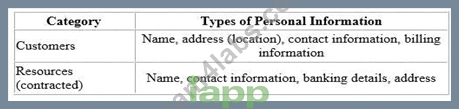
Clean-Q has an internal employee base of about 30 people. A recent privacy compliance exercise has been conducted to align employee data management and human resource functions with applicable data protection regulation. Therefore, the Clean-Q permanent employee base is not included as part of this scenario.
With an increase in construction work and housing developments, Clean-Q has had an influx of requests for cleaning services. The demand has overwhelmed Clean-Q's traditional supply and demand system that has caused some overlapping bookings.
Ina business strategy session held by senior management recently, Clear-Q invited vendors to present potential solutions to their current operational issues. These vendors included Application developers and Cloud-Q's solution providers, presenting their proposed solutions and platforms.
The Managing Director opted to initiate the process to integrate Clean-Q's operations with a cloud solution (LeadOps) that will provide the following solution one single online platform: A web interface that Clean-Q accesses for the purposes of resource and customer management. This would entail uploading resource and customer information.
* A customer facing web interface that enables customers to register, manage and submit cleaning service requests online.
* A resource facing web interface that enables resources to apply and manage their assigned jobs.
* An online payment facility for customers to pay for services.
What is a key consideration for assessing external service providers like LeadOps, which will conduct personal information processing operations on Clean-Q's behalf?
- A. Recognizing the value of LeadOps' website holding a verified security certificate.
- B. Establishing a relationship with the Managing Director of LeadOps.
- C. Obtaining knowledge of LeadOps' information handling practices and information security environment.
- D. Understanding LeadOps' costing model.
Answer: C
NEW QUESTION 38
SCENARIO
Please use the following to answer the next question:
Light Blue Health (LBH) is a healthcare technology company developing a new web and mobile application that collects personal health information from electronic patient health records. The application will use machine learning to recommend potential medical treatments and medications based on information collected from anonymized electronic health records. Patient users may also share health data collected from other mobile apps with the LBH app.
The application requires consent from the patient before importing electronic health records into the application and sharing it with their authorized physicians or healthcare provider. The patient can then review and share the recommended treatments with their physicians securely through the app. The patient user may also share location data and upload photos in the app. The patient user may also share location data and upload photos in the app for a healthcare provider to review along with the health record. The patient may also delegate access to the app.
LBH's privacy team meets with the Application development and Security teams, as well as key business stakeholders on a periodic basis. LBH also implements Privacy by Design (PbD) into the application development process.
The Privacy Team is conducting a Privacy Impact Assessment (PIA) to evaluate privacy risks during development of the application. The team must assess whether the application is collecting descriptive, demographic or any other user related data from the electronic health records that are not needed for the purposes of the application. The team is also reviewing whether the application may collect additional personal data for purposes for which the user did not provide consent.
What is the best way to ensure that the application only collects personal data that is needed to fulfill its primary purpose of providing potential medical and healthcare recommendations?
- A. Obtain consent before using personal health information for data analytics purposes.
- B. Disclose what personal data the application the collecting in the company Privacy Policy posted online.
- C. Document each personal category collected by the app and ensure it maps to an app function or feature.
- D. Provide the user with an option to select which personal data the application may collect.
Answer: B
NEW QUESTION 39
SCENARIO
Please use the following to answer the next question:
Chuck, a compliance auditor for a consulting firm focusing on healthcare clients, was required to travel to the client's office to perform an onsite review of the client's operations. He rented a car from Finley Motors upon arrival at the airport as so he could commute to and from the client's office. The car rental agreement was electronically signed by Chuck and included his name, address, driver's license, make/model of the car, billing rate, and additional details describing the rental transaction. On the second night, Chuck was caught by a red light camera not stopping at an intersection on his way to dinner. Chuck returned the car back to the car rental agency at the end week without mentioning the infraction and Finley Motors emailed a copy of the final receipt to the address on file.
Local law enforcement later reviewed the red light camera footage. As Finley Motors is the registered owner of the car, a notice was sent to them indicating the infraction and fine incurred. This notice included the license plate number, occurrence date and time, a photograph of the driver, and a web portal link to a video clip of the violation for further review. Finley Motors, however, was not responsible for the violation as they were not driving the car at the time and transferred the incident to AMP Payment Resources for further review. AMP Payment Resources identified Chuck as the driver based on the rental agreement he signed when picking up the car and then contacted Chuck directly through a written letter regarding the infraction to collect the fine.
After reviewing the incident through the AMP Payment Resources' web portal, Chuck paid the fine using his personal credit card. Two weeks later, Finley Motors sent Chuck an email promotion offering 10% off a future rental.
What is the most secure method Finley Motors should use to transmit Chuck's information to AMP Payment Resources?
- A. Transport Layer Security (TLS).
- B. HyperText Transfer Protocol (HTTP).
- C. Cloud file transfer services.
- D. Certificate Authority (CA).
Answer: A
NEW QUESTION 40
SCENARIO - Please use the following to answer the next question:
Kyle is a new security compliance manager who will be responsible for coordinating and executing controls to ensure compliance with the company s information security policy and industry standards. Kyle is also-new to the company, where collaboration is a core value. On his first day of new-hire orientation, Kyle s schedule included participating in meetings and observing work in the IT and compliance departments.
Kyle spent the morning in the IT department, where the CIO welcomed him and explained that her department was responsible for IT governance. The CIO and Kyle engaged in a conversation about the importance of identifying meaningful IT governance metrics. Following their conversation, the CIO introduced Kyle to Ted and Barney. Ted is implementing a plan to encrypt data at the transportation level of the organization s wireless network. Kyle would need to get up to speed on the project and suggest ways to monitor effectiveness once the implementation was complete. Barney explained that his short-term goals are to establish rules governing where data can be placed and to minimize the use of offline data storage.
Kyle spent the afternoon with Jill, a compliance specialist, and learned that she was exploring an initiative for a compliance program to follow self-regulatory privacy principles. Thanks to a recent internship, Kyle had some experience in this area and knew where Jill could find some support. Jill also shared results of the company s privacy risk assessment, noting that the secondary use of personal information was considered a high risk.
By the end of the day, Kyle was very excited about his new job and his new company. In fact, he learned about an open position for someone with strong qualifications and experience with access privileges, project standards board approval processes, and application-level obligations, and couldn't wait to recommend his friend Ben who would be perfect for the job.
Which of the following should Kyle recommend to Jill as the best source of support for her initiative?
- A. Investors.
- B. Industry groups.
- C. Regulators.
- D. Corporate researchers.
Answer: C
NEW QUESTION 41
A company configures their information system to have the following capabilities:
Allow for selective disclosure of attributes to certain parties, but not to others.
Permit the sharing of attribute references instead of attribute values - such as "I am over 21" instead of birthday date.
Allow for information to be altered or deleted as needed.
These capabilities help to achieve which privacy engineering objective?
- A. Predictability.
- B. Manageability.
- C. Disassociability.
- D. Integrity.
Answer: C
NEW QUESTION 42
Which of the following is an example of the privacy risks associated with the Internet of Things (loT)?
- A. A group of hackers infiltrate a power grid and cause a major blackout.
- B. A website stores a cookie on a user's hard drive so the website can recognize the user on subsequent visits.
- C. An insurance company raises a person's rates based on driving habits gathered from a connected car.
- D. A water district fines an individual after a meter reading reveals excess water use during drought conditions.
Answer: C
NEW QUESTION 43
What is the main function of the Amnesic Incognito Live System or TAILS device?
- A. It encrypts data stored on any computer on a network.
- B. It allows the user to run a self-contained computer from a USB device.
- C. It causes a system to suspend its security protocols.
- D. It accesses systems with a credential that leaves no discernable tracks.
Answer: B
Explanation:
Explanation/Reference: https://www.wired.co.uk/article/tails-operating-software
NEW QUESTION 44
Which of the following are the mandatory pieces of information to be included in the documentation of records of processing activities for an organization that processes personal data on behalf of another organization?
- A. Contact details of the processor and Data Protection Offer (DPO).
- B. Time limits for erasure of different categories of data.
- C. Descriptions of the processing activities and relevant data subjects.
- D. Copies of the consent forms from each data subject.
Answer: B
NEW QUESTION 45
What is a main benefit of data aggregation?
- A. It applies two or more layers of protection to a single data record.
- B. It is a good way to perform analysis without needing a statistician.
- C. It allows one to draw valid conclusions from small data samples.
- D. It is a good way to achieve de-identification and unlinkabilty.
Answer: C
Explanation:
Explanation/Reference:
NEW QUESTION 46
What Privacy by Design (PbD) element should include a de-identification or deletion plan?
- A. Retention.
- B. Categorization.
- C. Security
- D. Remediation.
Answer: A
NEW QUESTION 47
Properly configured databases and well-written website codes are the best protection against what online threat?
- A. Pharming.
- B. Malware execution.
- C. SQL injection.
- D. System modification.
Answer: C
NEW QUESTION 48
Which of the following is considered a records management best practice?
- A. Storing decryption keys with their associated backup systems.
- B. Implementing consistent handling practices across all record types. ID.
- C. Using classification to determine access rules and retention policy.
- D. Archiving expired data records and files.
Answer: C
NEW QUESTION 49
SCENARIO
Looking back at your first two years as the Director of Personal Information Protection and Compliance for the Berry Country Regional Medical Center in Thorn Bay, Ontario, Canada, you see a parade of accomplishments, from developing state-of-the-art simulation based training for employees on privacy protection to establishing an interactive medical records system that is accessible by patients as well as by the medical personnel. Now, however, a question you have put off looms large: how do we manage all the data-not only records produced recently, but those still on hand from years ago? A data flow diagram generated last year shows multiple servers, databases, and work stations, many of which hold files that have not yet been incorporated into the new records system. While most of this data is encrypted, its persistence may pose security and compliance concerns. The situation is further complicated by several long-term studies being conducted by the medical staff using patient information. Having recently reviewed the major Canadian privacy regulations, you want to make certain that the medical center is observing them.
You also recall a recent visit to the Records Storage Section, often termed "The Dungeon" in the basement of the old hospital next to the modern facility, where you noticed a multitude of paper records. Some of these were in crates marked by years, medical condition or alphabetically by patient name, while others were in undifferentiated bundles on shelves and on the floor. The back shelves of the section housed data tapes and old hard drives that were often unlabeled but appeared to be years old. On your way out of the dungeon, you noticed just ahead of you a small man in a lab coat who you did not recognize. He carried a batch of folders under his arm, apparently records he had removed from storage.
Which cryptographic standard would be most appropriate for protecting patient credit card information in the records system?
- A. Obfuscation
- B. Symmetric Encryption
- C. Hashing
- D. Asymmetric Encryption
Answer: D
NEW QUESTION 50
Which of the following became a foundation for privacy principles and practices of countries and organizations across the globe?
- A. The Code of Fair Information Practices.
- B. The Organization for Economic Co-operation and Development (OECD) Privacy Principles.
- C. The EU Data Protection Directive.
- D. The Personal Data Ordinance.
Answer: B
NEW QUESTION 51
Which of the following entities would most likely be exempt from complying with the General Data Protection Regulation (GDPR)?
- A. A company that stores all customer data in Australia and is headquartered in a European Union (EU) member state.
- B. A Chinese company that has opened a satellite office in a European Union (EU) member state to service European customers.
- C. A South American company that regularly collects European customers' personal data.
- D. A North American company servicing customers in South Africa that uses a cloud storage system made by a European company.
Answer: B
NEW QUESTION 52
SCENARIO
It should be the most secure location housing data in all of Europe, if not the world. The Global Finance Data Collective (GFDC) stores financial information and other types of client data from large banks, insurance companies, multinational corporations and governmental agencies. After a long climb on a mountain road that leads only to the facility, you arrive at the security booth. Your credentials are checked and checked again by the guard to visually verify that you are the person pictured on your passport and national identification card.
You are led down a long corridor with server rooms on each side, secured by combination locks built into the doors. You climb a flight of stairs and are led into an office that is lighted brilliantly by skylights where the GFDC Director of Security, Dr. Monique Batch, greets you. On the far wall you notice a bank of video screens showing different rooms in the facility. At the far end, several screens show different sections of the road up the mountain Dr. Batch explains once again your mission. As a data security auditor and consultant, it is a dream assignment: The GFDC does not want simply adequate controls, but the best and most effective security that current technologies allow.
"We were hacked twice last year," Dr. Batch says, "and although only a small number of records were stolen, the bad press impacted our business. Our clients count on us to provide security that is nothing short of impenetrable and to do so quietly. We hope to never make the news again." She notes that it is also essential that the facility is in compliance with all relevant security regulations and standards.
You have been asked to verify compliance as well as to evaluate all current security controls and security measures, including data encryption methods, authentication controls and the safest methods for transferring data into and out of the facility. As you prepare to begin your analysis, you find yourself considering an intriguing question: Can these people be sure that I am who I say I am?
You are shown to the office made available to you and are provided with system login information, including the name of the wireless network and a wireless key. Still pondering, you attempt to pull up the facility's wireless network, but no networks appear in the wireless list. When you search for the wireless network by name, however it is readily found.
Why would you recommend that GFC use record encryption rather than disk, file or table encryption?
- A. Record encryption involves tag masking, so its metadata cannot be decrypted
- B. Record encryption is granular, limiting the damage of potential breaches.
- C. Record encryption is asymmetric, a stronger control measure.
- D. Record encryption allows for encryption of personal data only.
Answer: B
Explanation:
Explanation
NEW QUESTION 53
What term describes two re-identifiable data sets that both come from the same unidentified individual?
- A. Aggregated data.
- B. Pseudonymous data.
- C. Anonymous data.
- D. Imprecise data.
Answer: C
NEW QUESTION 54
Which of the following entities would most likely be exempt from complying with the General Data Protection Regulation (GDPR)?
- A. A South American company that regularly collects European customers personal data.
- B. A company that stores all customer data in Australia and is headquartered in a European Union (EU) member state.
- C. A North American company servicing customers in South Africa that uses a cloud storage system made by a European company.
- D. A Chinese company that has opened a satellite office in a European Union (EU) member state to service European customers.
Answer: B
NEW QUESTION 55
SCENARIO - Please use the following to answer the next question:
Looking back at your first two years as the Director of Personal Information Protection and Compliance for the Berry Country Regional Medical Center in Thorn Bay, Ontario, Canada, you see a parade of accomplishments, from developing state-of-the-art simulation based training for employees on privacy protection to establishing an interactive medical records system that is accessible by patients as well as by the medical personnel. Now, however, a question you have put off looms large: how do we manage all the data-not only records produced recently, but those still on hand from years ago? A data flow diagram generated last year shows multiple servers, databases, and work stations, many of which hold files that have not yet been incorporated into the new records system. While most of this data is encrypted, its persistence may pose security and compliance concerns. The situation is further complicated by several long-term studies being conducted by the medical staff using patient information. Having recently reviewed the major Canadian privacy regulations, you want to make certain that the medical center is observing them.
SCENARIO - Please use the following to answer the next question:
Looking back at your first two years as the Director of Personal Information Protection and Compliance for the Berry Country Regional Medical Center in Thorn Bay, Ontario, Canada, you see a parade of accomplishments, from developing state-of-the-art simulation based training for employees on privacy protection to establishing an interactive medical records system that is accessible by patients as well as by the medical personnel. Now, however, a question you have put off looms large: how do we manage all the data-not only records produced recently, but those still on hand from years ago? A data flow diagram generated last year shows multiple servers, databases, and work stations, many of which hold files that have not yet been incorporated into the new records system. While most of this data is encrypted, its persistence may pose security and compliance concerns. The situation is further complicated by several long-term studies being conducted by the medical staff using patient information. Having recently reviewed the major Canadian privacy regulations, you want to make certain that the medical center is observing them.
You also recall a recent visit to the Records Storage Section, often termed :The Dungeon" in the basement of the old hospital next to the modern facility, where you noticed a multitude of paper records. Some of these were in crates marked by years, medical condition or alphabetically by patient name, while others were in undifferentiated bundles on shelves and on the floor. The back shelves of the section housed data tapes and old hard drives that were often unlabeled but appeared to be years old. On your way out of the dungeon, you noticed just ahead of you a small man in a lab coat who you did not recognize. He carried a batch of folders under his arm, apparently records he had removed from storage.
Which data lifecycle phase needs the most attention at this Ontario medical center?
- A. Collection.
- B. Use.
- C. Retention.
- D. Disclosure
Answer: D
NEW QUESTION 56
A sensitive biometrics authentication system is particularly susceptible to?
- A. False negatives.
- B. Theft of finely individualized personal data.
- C. False positives.
- D. Slow recognition speeds.
Answer: C
NEW QUESTION 57
SCENARIO - Please use the following to answer the next question:
Clean-Q is a company that offers house-hold and office cleaning services. The company receives requests from consumers via their website and telephor, to book cleaning services. Based on the type and size of service, Clean-Q then contracts individuals that are registered on its resource database - currently managed in-house by Clean-Q IT Support. Because of Clean-Q:s business.
model, resources are contracted as needed instead of permanently employed.
The table below indicates some of the personal information Clean-Q requires as part of its business operations: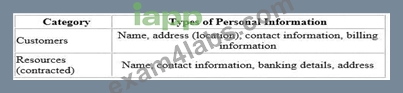
Clean-Q has an internal employee base of about 30 people. A recent privacy compliance exercise has been conducted to align employee data management and human resource functions with applicable data protection regulation.
Therefore, the Clean-Q permanent employee base is not included as part of this scenario.
With an increase in construction work and housing developments, Clean-Q has had an influx of requests for cleaning services. The demand has overwhelmed Clean-Q:s traditional supply and demand system that has caused some overlapping bookings.
In a business statrategy session held by senior management recently, Clearning invited vendors to present potential solutions to their current operational issues. These vendors includes included Application development and Cloud solution providers, presenting their proposed solution and platforms.
The Managing Direct opted to initiate the process to integrate Clean-Q's operations with a cloud solution (LeadOps) that will provide the following solution one single online platform. A web interface that Clean-Q accesses for the purposes of resource and customer management. This would entail uploading resource and customer information.
A customer facing web interface that enables customers to register, manage and submit cleaning service requests online.
A resource facing web interface that enables resources to apply and manage their assigned jobs.
An online payment facility for customer to pay for services.
What is a key consideration for assessing external service providers like LeadOps, which will conduct personal information processing operations on Clean-Q:s behalf?
- A. Understanding LeadOps costing model.
- B. Recognizing the value of LeadOps website holding a verified security certificate.
- C. Obtaining knowledge of LeadOps information handling practices and information security environment.
- D. Establishing a relationship with the Managing Director of LeadOps.
Answer: D
NEW QUESTION 58
What was the first privacy framework to be developed?
- A. The Asia-Pacific Economic Cooperation (APEC) Privacy Framework.
- B. Generally Accepted Privacy Principles.
- C. Code of Fair Information Practice Principles (FIPPs).
- D. OECD Privacy Principles.
Answer: D
NEW QUESTION 59
......
Latest 100% Passing Guarantee - Brilliant CIPT Exam Questions PDF: https://actual4test.exam4labs.com/CIPT-practice-torrent.html