

NCA-6.5 Dumps with Practice Exam Questions Answers
NCA-6.5 by Nutanix Certified Associate (NCA) Actual Free Exam Practice Test
Nutanix NCA-6.5 (Nutanix Certified Associate (NCA) v6.5) Certification Exam is an essential certification for individuals who want to advance their career in cloud computing. Nutanix Certified Associate (NCA) v6.5 exam certification demonstrates an individual's knowledge and skills in managing Nutanix solutions effectively. Nutanix offers various resources to help individuals prepare for the exam, including online courses, practice exams, and study guides. The NCA-6.5 certification is an excellent investment for individuals who want to enhance their career prospects and for businesses who want to ensure that their employees have the necessary skills to manage their Nutanix solutions effectively.
Nutanix NCA-6.5 (Nutanix Certified Associate v6.5) exam is a certification exam designed for IT professionals who wish to validate their knowledge and skills in the installation, configuration, and management of Nutanix products. NCA-6.5 exam is an entry-level certification that is ideal for individuals who are interested in pursuing a career in cloud computing or hyper-converged infrastructure.
Nutanix NCA-6.5 (Nutanix Certified Associate (NCA) v6.5) exam is a certification exam designed for IT professionals who want to validate their skills and knowledge in managing, configuring, and maintaining Nutanix infrastructure. NCA-6.5 exam is ideal for those who work with Nutanix solutions and want to enhance their career prospects and credibility in the industry.
NEW QUESTION # 61
An administrator receives an alert that a node has failed within a Nutanix AHV-based 10-node cluster. Before the failure, the cluster CPU and memory utilization was around 50%.
What actions will the cluster automatically take?
- A. The cluster will enter read-only mode and the VMs will be powered down to preserve data.
- B. VMs will migrate to other nodes in the cluster with no user impact.
- C. VMs will be unavailable until the affected host is fully functional.
- D. All HA-protected VMs will be automatically restarted on other nodes in the cluster.
Answer: D
Explanation:
Nutanix supports high availability (HA) for VMs by automatically restarting them on other nodes in the cluster in case of a node failure. The cluster CPU and memory utilization will increase temporarily until the failed node is recovered, but there will be no user impact. Reference: https://www.nutanix.com/content/dam/nutanix/resources/misc/ebg-nca-6-5.pdf (page 28)
NEW QUESTION # 62
An administrator has defined a security policy that needs to be applied to dozens of VMs. What is the most efficient way the administrator can perform this?
- A. Apply the same label to all the VMs, then bind the policy to the label.
- B. Use a script to apply the policy to the defined VMs.
- C. Apply a category to the VMs. and associate the category with the policy.
- D. Within the policy, select all the VMs it should be applied to.
Answer: A
Explanation:
Labels allow administrators to group related objects, such as VMs, and then apply policies to those labels, rather than having to manually apply the policy to each individual VM. This is the most efficient way for an administrator to apply a security policy to dozens of VMs. Reference: https://portal.nutanix.com/page/documents/details?targetId=Platform-Administrator-Guide-v5_7:pag-sec-category-label-c.html
NEW QUESTION # 63
What happens to images that are imported into Prism Central?
- A. Remain in the source duster after import
- B. Copied to all clusters managed by Prism Central
- C. Deleted from the source cluster after import
- D. Copied to the Prism Central image repository
Answer: D
Explanation:
The Prism Central image repository is a centralized location for storing virtual machine images that can be used to deploy VMs to any cluster managed by Prism Central. When an image is imported into Prism Central, a copy of the image is made and stored in the repository, so that it can be easily accessed and deployed to any cluster as needed.
The original image file typically remains in the source cluster after it is imported into Prism Central, unless it is explicitly deleted. Similarly, the image copy in the Prism Central repository is not automatically copied to all clusters managed by Prism Central, but can be used to deploy new VMs on any cluster as needed.
NEW QUESTION # 64
An administrator needs to deploy a two-node cluster on a new ROBO Site. What is required to maintain High Availability in the case of a node failure?
- A. Async Replication
- B. Witness VM
- C. Windows Failover Clustering
- D. Metro-Availability
Answer: D
Explanation:
Metro-Availability is a feature of Nutanix clusters that provides high availability in the case of a node failure. It requires two nodes and uses asynchronous replication between the two sites to ensure that data is replicated across the two sites in real-time. This ensures that, in the case of a node failure, the data is still available and the cluster can remain operational. Reference: https://portal.nutanix.com/page/documents/details?targetId=Platform-Administrator-Guide-v5_7:pag-metro-availability-c.html
NEW QUESTION # 65
Refer to the exhibit.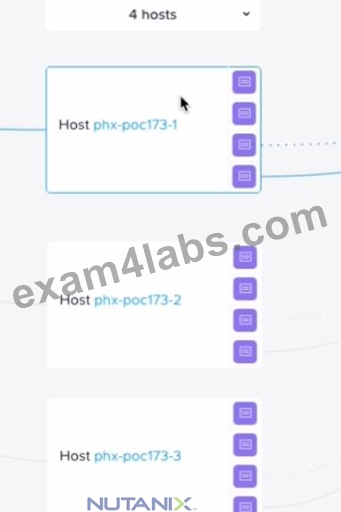
What is true about the network uplink ports?
- A. All are connected, but only two are carrying traffic.
- B. They are configured in Active-Backup mode.
- C. They are configured in Active-Active mode.
- D. One is connected at 1GbE and the other is 10GbE.
Answer: B
Explanation:
In Nutanix, all the network uplink ports are connected, but only two of them are carrying traffic at any given time. This is done to provide redundancy and failover in case one of the ports fails. The two ports that are carrying traffic are chosen based on the link aggregation policy configured. The link aggregation policy can be configured to use either Active-Active or Active-Backup mode. In Active-Active mode, both ports are active and carrying traffic, while in Active-Backup mode, only one port is active and carrying traffic, the other port is on standby. Reference: https://portal.nutanix.com/page/documents/details?targetId=Web-Console-Guide-Prism-v5_11:wc-network-configuring-uplink-ports_wc-network-configuring-uplink-ports.html
NEW QUESTION # 66
An administrator receives several alerts indicating a Nutanix cluster is running out of memory. As a preemptive measure, the administrator wishes to try to reduce the consumed resources, if possible.
Which two predefined views for Reporting best display potentially reclaimable resources? (Choose two.)
- A. list of Bully VMs
- B. Memory Runway
- C. List of Overprovisioned VMs
- D. List of Inactive VMs
Answer: C,D
Explanation:
To display potentially reclaimable resources in a Nutanix cluster running out of memory, an administrator can use the List of Inactive VMs and List of Overprovisioned VMs predefined views for Reporting
NEW QUESTION # 67
How many copies of metadata are written for a Replication Factor of 2 (RF2)?
- A. 0
- B. l
- C. 1
- D. 2
Answer: D
NEW QUESTION # 68
An Administrator has created a Volume Group for a specific VM on an AHV Cluster.
What is the next step required to user vDisk in the VM?
- A. Configure CHAP Authentication
- B. Attach the Volume Group to the VM
- C. Reboot the VMD. Bring the disk Online
Answer: B
NEW QUESTION # 69
Which feature or configuration is best for securing network traffic between the management and storage replication environments?
- A. Network Segmentation
- B. Use of Firewall Rules
- C. Different Storage Containers
- D. VM Anti-Affinity Rules
Answer: A
Explanation:
Network segmentation is the best feature or configuration for securing network traffic between the management and storage replication environments. Network segmentation is the practice of dividing a computer network into subnets, each serving a different purpose or function. By dividing the network into different segments, it is possible to control and monitor the flow of traffic between the different segments, and to implement different security policies for each segment.
For example, the management environment could be segmented from the storage replication environment, and only specific traffic, such as management traffic, would be allowed to flow between the two segments. This can help to protect the management environment from potential security threats that may originate from the storage replication environment.
Other options like firewall rules, VM anti-affinity rules, and different storage containers can also help to secure network traffic, but network segmentation provides a more comprehensive and granular way to secure the traffic between different environments.
You can find more information on this topic in the Nutanix Security Configuration Guide, which is available on the Nutanix support website: https://portal.nutanix.com/#/page/docs/details?targetId=Security-Guide-v5_24:Security-Guide-v5_24
NEW QUESTION # 70
An administrator notices that a VM is slow and unresponsive. The administrator wants to compare performance to other VMs on cluster.
Which chart type is best suited to display multiple VM performance metrics for diagnosis?
- A. Entity Chart
- B. Dashboard Chart
- C. Analysis Chart
- D. Metric Chart
Answer: C
Explanation:
To compare the performance of multiple VMs on a Nutanix cluster, an administrator can use an Analysis Chart. Analysis Charts allow administrators to view and compare performance metrics for multiple entities, such as VMs, over time. This can help the administrator diagnose performance issues by comparing the performance of the slow and unresponsive VM to other VMs on the cluster
NEW QUESTION # 71
A SQL Server cluster has been deployed on an AHV cluster. To ensure maximum uptime, the administrator wants the SQL Server VMs running on different hosts while leveraging High Availability in case of host failure.
Which configuration would meet these requirements?
- A. Create an anti-affinity rule via CLI.
- B. Configure one VM as an Agent VM
- C. Disable Host affinity rules in the cluster
- D. Disable VM live migration from selected VMs.
Answer: A
Explanation:
Anti-affinity rules are used to ensure that virtual machines are not running on the same physical host. This can be useful in situations where the administrator wants to ensure that virtual machines are running on different hosts for high availability and to minimize the impact of a host failure. By creating an anti-affinity rule via CLI, the administrator can ensure that the SQL Server VMs are running on different hosts while still leveraging high availability in case of host failure. Reference: https://portal.nutanix.com/page/documents/details?targetId=Web-Console-Guide-Prism-v5_11:wc-affinity-anti-affinity-rules_wc-affinity-anti-affinity-rules.html
NEW QUESTION # 72
User are complaining that web application hosted on a Nutanix cluster are running slow. After reviewing the performance metric, it is determined that the CPU Ready time is high in the cluster.
What entity is impacted by CPU ready time?
- A. VM
- B. vDisk
- C. Oplog
- D. NIC
Answer: C
Explanation:
The oplog is a critical component of the Nutanix distributed storage fabric and can be impacted by high CPU Ready time. When the CPU Ready time is high, there can be delays in writing data to the oplog, resulting in slower overall cluster performance. Additionally, high CPU Ready time can also lead to increased write amplification, further reducing I/O performance.
NEW QUESTION # 73
An organization runs several core business applications on a Nutanix cluster. System stability and support are critical for these applications, which has an annual maintenance window.
How can the administrator assure that these requirements are met?
- A. Adhere to the LTS release cycle.
- B. Purchase Ultimate licensing.
- C. Purchase Mission Critical support.
- D. Adhere to the STS release cycle.
Answer: A
Explanation:
To assure system stability and support for critical applications running on a Nutanix cluster, the administrator can adhere to the LTS (Long Term Support) release cycle. LTS releases provide stability and long-term support, with a focus on maintenance and bug fixes rather than new features. This can help ensure that the system remains stable and supported during the annual maintenance window
NEW QUESTION # 74
Which AHV feature proactively monitors a Nutanix cluster for compute and storage I/O contention or hot-spots over a period of time?
- A. Prism
- B. ADS
- C. Genesis
- D. Cluster Maintenance Utility
Answer: B
Explanation:
ADS is a feature of Nutanix AHV (Acropolis Hypervisor) that proactively monitors a Nutanix cluster for compute and storage I/O contention or hotspots over a period of time [1]. It provides dynamic and intelligent scheduling of workloads on the cluster for optimal performance and utilization.
NEW QUESTION # 75
Which technology provides Nutanix's native virtualization solution?
- A. AHV
- B. App Mobility Fabric
- C. CVM
- D. Distributed Storage Fabric
Answer: A
NEW QUESTION # 76
In Prism Element, to which object are policies such as replication factor and storage efficiency settings applied?
- A. Storage Pool
- B. Container
- C. Virtual Machine
- D. vBlock
Answer: B
Explanation:
In Prism Element, policies such as replication factor and storage efficiency settings are applied to Containers. A container is a logical grouping of one or more storage pools and defines the storage resources available to virtual machines. By applying policies to a container, you can set the replication factor, storage efficiency settings, and other storage-related settings for all of the virtual machines that are associated with that container. This is a fundamental concept in Nutanix Platform.
NEW QUESTION # 77
What is the minimum number of blocks required to utilize block awareness?
- A. 0
- B. 1
- C. 2
- D. 3
Answer: C
NEW QUESTION # 78
An administrator needs to check which users have created VMs within the previous two weeks.
How can the administrator satisfy this task?
- A. Use Analysis Page in Prism Element and adjust time range
- B. CSV export Events list from Prism Central page
- C. Sort operation messages in Prism Element Tasks page
- D. Create a filter in Prism Central Audits page
Answer: D
NEW QUESTION # 79
An administrator needs to expand a Nutanix cluster that is tagging the network traffic at the CVM and AHV level. However, the administrator doesn't remember the configured VLAN ID.
Which command can the administrator run to find the correct VLAN ID from the CVM?
- A. ovs-vscl
- B. acli
- C. ifconfig
- D. manage-ovs
Answer: D
Explanation:
The manage-ovs command can be used to find the correct VLAN ID from the CVM, as it allows the administrator to view and configure network settings for Open vSwitch (OVS). The ifconfig command can be used to view network interfaces and IP addresses, but not VLAN IDs. The acli command can be used to manage Acropolis services and objects, but not network settings. The ovs-vsctl command can be used to view and configure OVS settings, but it is not available on the CVM. Reference: https://www.nutanix.com/content/dam/nutanix/resources/misc/ebg-nca-6-5.pdf (page 38)
NEW QUESTION # 80
An administrator needs to upgrade AOS for an air gapped cluster by using Prism Element.
Which two actions allow the administrator to perform the upgrade? Choose Two
- A. Manually Upload AOS binaries and metadata
- B. Manually Upload Binaries to a local http server
- C. Extract the AOS binaries to the CVM
- D. Use the LCM dark site Option Providing AOS Binaries
Answer: A,D
NEW QUESTION # 81
Where can an administrator configure role-based access control (RBAC)?
- A. Prism Central
- B. Self-Service Restore
- C. Foundation
- D. Prism Element
Answer: A
Explanation:
Role-based access control (RBAC) allows administrators to configure access control for different users and groups in the Nutanix cluster. This feature is available through Prism Central, where administrators can configure roles and permissions for different users and groups. Reference: https://portal.nutanix.com/page/documents/details?targetId=Platform-Administrator-Guide-v5_7:pag-user-role-c.html
NEW QUESTION # 82
A single host in a four-node AHV-based cluster experiences a complete network failure.
If more than enough resources exist in the cluster to tolerate a node failure, what happens to the user VMs running on that host?
- A. VMs are live-migrated to the three remaining hosts.
- B. VMs remain down until network connectivity is restored.
- C. VMs stay up, but are unreachable until connectivity is restored.
- D. VMs automatically restart on the three remaining hosts.
Answer: C
Explanation:
In the case of a single host in a four-node AHV-based cluster experiencing a complete network failure, the user VMs running on that host will stay up, but will be unreachable until connectivity is restored. This is because if more than enough resources exist in the cluster to tolerate a node failure, the VMs will continue to run, but will be unable to communicate with other nodes in the cluster due to the network failure. This is stated in the official Nutanix Certified Associate (NCA) v6.5 study guide on page 49, under the heading "Virtual Machine Availability in the Event of Node Failure".
NEW QUESTION # 83
Refer to the exhibit.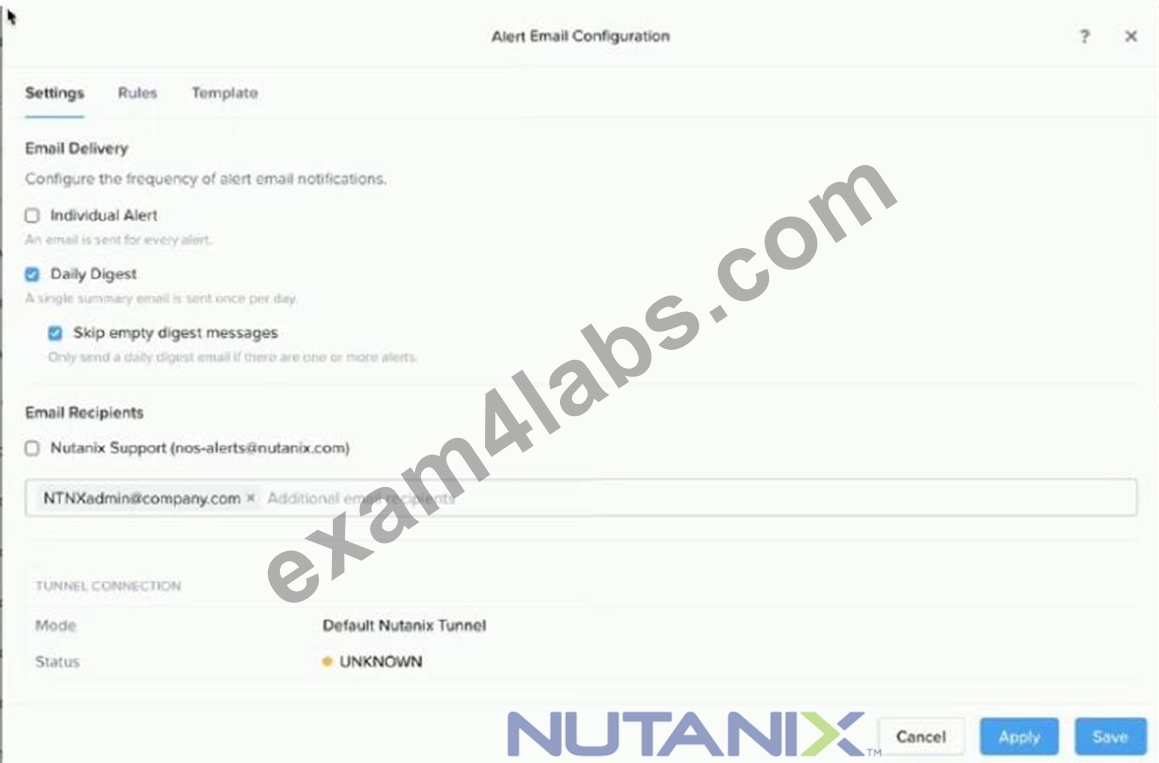
An administrator has configured Prism Central to email daily digests of alerts on a cluster. After a week, the administrator notices that digests are not being received.
What is the most likely cause of the issue?
- A. The SMTP server is not configured properly.
- B. Nutanix support is not enabled as a recipient.
- C. The recipient address is no" registered with Nutanix.
- D. The tunnel connection has not been enabled.
Answer: A
NEW QUESTION # 84
Refer to the exhibit.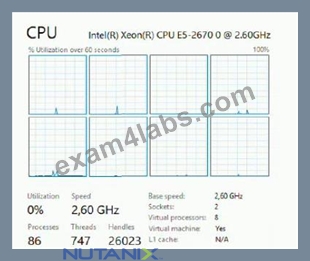
An administrator needs to upgrade a VM to 10 virtual processors. Which action should the administrator take to complete this task?
- A. Update the VM adding two cores
- B. Power-off the VM and add one core
- C. Update the VM adding two vCPUs
- D. Power-off the VM and add one vCPU
Answer: A
NEW QUESTION # 85
......
Free Nutanix Certified Associate (NCA) NCA-6.5 Exam Question: https://actual4test.exam4labs.com/NCA-6.5-practice-torrent.html