

[Apr-2024] Updated CompTIA DS0-001 Dumps – PDF & Online Engine
DS0-001.pdf - Questions Answers PDF Sample Questions Reliable
NEW QUESTION # 43
Which of the following is a characteristic of all non-relational databases?
- A. Columns with the same data type
- B. Tabular schema
- C. Unstructured data
- D. Logical record groupings
Answer: C
Explanation:
The characteristic of all non-relational databases is unstructured data. Unstructured data is data that does not have a predefined or fixed format, schema, or structure. Unstructured data can include various types of data, such as text, images, audio, video, etc. Non-relational databases, also known as NoSQL databases, are databases that store and manage unstructured data using different models, such as key-value, document, graph, columnar, etc. Non-relational databases are suitable for handling large volumes, variety, and velocity of data that do not fit well in the relational model. The other options are either characteristics of relational databases or not related to database types at all. For example, columns with the same data type, logical record groupings, and tabular schema are characteristics of relational databases, which are databases that store and manage structured data using tables, rows, columns, and constraints. Reference: CompTIA DataSys+ Course Outline, Domain 1.0 Database Fundamentals, Objective 1.1 Given a scenario, identify common database types.
NEW QUESTION # 44
Which of the following best describes a collection of data that shares the same properties or attributes?
- A. Entity set
- B. ER model
- C. Tuples
- D. Relation set
Answer: A
Explanation:
The option that best describes a collection of data that shares the same properties or attributes is entity set. An entity set is a term used in the entity-relationship (ER) model, which is a conceptual model for designing and representing databases. An entity set is a collection of entities that have the same type or characteristics, such as students, courses, products, etc. An entity is an object or thing that can be identified and distinguished from others, such as a specific student, course, product, etc. An entity set can have one or more attributes that describe the properties or features of the entities, such as name, age, price, etc. An entity set can also have one or more relationships with other entity sets that define how the entities are associated or connected, such as enrolled, taught by, purchased by, etc. The other options are either different terms or not related to the ER model at all. For example, relation set is a term used in the relational model, which is a logical model for implementing and manipulating databases; ER model is a term used to refer to the entity-relationship model itself; tuples are rows or records in a table or relation. Reference: CompTIA DataSys+ Course Outline, Domain 1.0 Database Fundamentals, Objective 1.1 Given a scenario, identify common database types.
NEW QUESTION # 45
Which of the following constraints is used to enforce referential integrity?
- A. Foreign key
- B. Primary key
- C. Surrogate key
- D. Unique key
Answer: A
Explanation:
The constraint that is used to enforce referential integrity is foreign key. A foreign key is a column or a set of columns in a table that references the primary key of another table. A primary key is a column or a set of columns in a table that uniquely identifies each row in the table. Referential integrity is a rule that ensures that the values in the foreign key column match the values in the primary key column of the referenced table. Referential integrity helps maintain the consistency and accuracy of the data across related tables. The other options are either different types of constraints or not related to referential integrity at all. For example, a surrogate key is a column that is artificially generated to serve as a primary key, such as an auto-increment number or a GUID (Globally Unique Identifier); a unique key is a column or a set of columns in a table that uniquely identifies each row in the table, but it can have null values unlike a primary key; there is no such constraint as TID. Reference: CompTIA DataSys+ Course Outline, Domain 1.0 Database Fundamentals, Objective 1.2 Given a scenario, execute database tasks using scripting and programming languages.
NEW QUESTION # 46
A database administrator wants to remove inactive customers from a database. Which of the following statements should the administrator use?
- A.

- B.

- C.

- D.

Answer: D
Explanation:
The statement that the administrator should use to remove inactive customers from a database is option A. This statement uses the DELETE command to delete all the rows from the customer table where the status column is equal to 'inactive'. The other options either have syntax errors, use incorrect commands, or do not specify the condition correctly. Reference: CompTIA DataSys+ Course Outline, Domain 1.0 Database Fundamentals, Objective 1.2 Given a scenario, execute database tasks using scripting and programming languages.
NEW QUESTION # 47
Which of the following have data manipulation and procedural scripting power? (Choose two.)
- A. PL/SQL
- B. SQL
- C. Advanced
- D. T-SQL
- E. PQL
- F. SQL
Answer: A,D
Explanation:
The two options that have data manipulation and procedural scripting power are PL/SQL and T-SQL. PL/SQL, or Procedural Language/Structured Query Language, is an extension of SQL that adds procedural features to SQL for Oracle databases. PL/SQL allows users to create and execute stored procedures, functions, triggers, packages, etc., using variables, loops, conditions, exceptions, etc., in addition to SQL commands. PL/SQL helps improve the performance, functionality, modularity, and security of SQL queries and applications. T-SQL, or Transact-SQL, is an extension of SQL that adds procedural features to SQL for Microsoft SQL Server databases. T-SQL allows users to create and execute stored procedures, functions, triggers, etc., using variables, loops, conditions, exceptions, etc., in addition to SQL commands. T-SQL helps improve the performance, functionality, modularity, and security of SQL queries and applications. The other options are either not related or not having both data manipulation and procedural scripting power. For example, PQL, or Power Query Language, is a data analysis and transformation language for Microsoft Power BI and Excel; Advanced SQL is a term that refers to the advanced features or techniques of SQL, such as subqueries, joins, aggregations, etc.; SQL, or Structured Query Language, is a standard language for manipulating and querying data in relational databases, but it does not have procedural features. Reference: CompTIA DataSys+ Course Outline, Domain 1.0 Database Fundamentals, Objective 1.2 Given a scenario, execute database tasks using scripting and programming languages.
NEW QUESTION # 48
Which of the following best describes the category of SQL commands required to revoke access to database objects?
- A. DCL
- B. IDDL
- C. TCL
- D. IDML
Answer: A
Explanation:
The category of SQL commands that is required to revoke access to database objects is DCL. DCL, or Data Control Language, is a subset of SQL commands that are used to control or manage the access or permissions of users or roles on a database. DCL includes commands such as GRANT and REVOKE. GRANT is a DCL command that is used to grant privileges or roles to users or roles on specific objects in a database, such as tables, views, procedures, etc. REVOKE is a DCL command that is used to revoke privileges or roles from users or roles on specific objects in a database. For example, the following statement uses the REVOKE command to revoke the SELECT privilege from user Alice on table employee:
REVOKE SELECT ON employee FROM Alice;
The other options are either different categories of SQL commands or not related to SQL commands at all. For example, IDDL is not a valid acronym or category of SQL commands; IDML is not a valid acronym or category of SQL commands; TCL, or Transaction Control Language, is a subset of SQL commands that are used to control or manage transactions on a database, such as committing or rolling back changes. Reference: CompTIA DataSys+ Course Outline, Domain 4.0 Data and Database Security, Objective 4.2 Given a scenario, implement security controls for databases.
NEW QUESTION # 49
A new retail store employee needs to be able to authenticate to a database. Which of the following commands should a database administrator use for this task?
- A. CREATE USER
- B. ALLOW USER
- C. ALTER USER
- D. INSERT USER
Answer: A
Explanation:
The command that the database administrator should use for this task is CREATE USER. The CREATE USER command is a SQL statement that creates a new user account in a database and assigns it a username and a password. The CREATE USER command also allows the database administrator to specify other options or attributes for the user account, such as default tablespace, quota, profile, role, etc. The CREATE USER command is the first step to enable a user to authenticate to a database. The other options are either invalid or not suitable for this task. For example, INSERT USER is not a valid SQL command; ALLOW USER is not a SQL command, but a keyword used in some database systems to grant permissions to users; ALTER USER is a SQL command that modifies an existing user account, but does not create a new one. Reference: CompTIA DataSys+ Course Outline, Domain 4.0 Data and Database Security, Objective 4.2 Given a scenario, implement security controls for databases.
NEW QUESTION # 50
Which of the following is used to hide data in a database so the data can only be read by a user who has a key?
- A. Data protection
- B. Data security
- C. Data masking
- D. Data encryption
Answer: D
Explanation:
The option that is used to hide data in a database so the data can only be read by a user who has a key is data encryption. Data encryption is a process that transforms data into an unreadable or scrambled form using an algorithm and a key. Data encryption helps protect data from unauthorized access or modification by third parties, such as hackers, eavesdroppers, or interceptors. Data encryption also helps verify the identity and authenticity of the source and destination of the data using digital signatures or certificates. Data encryption can be applied to data at rest (stored in a database) or data in transit (transmitted over a network). To read encrypted data, a user needs to have the corresponding key to decrypt or restore the data to its original form. The other options are either different concepts or not related to hiding data at all. For example, data security is a broad term that encompasses various methods and techniques to protect data from threats or risks; data masking is a technique that replaces sensitive data with fictitious but realistic data to protect its confidentiality or compliance; data protection is a term that refers to the legal or ethical obligations to safeguard personal or sensitive data from misuse or harm. Reference: CompTIA DataSys+ Course Outline, Domain 4.0 Data and Database Security, Objective 4.2 Given a scenario, implement security controls for databases.
NEW QUESTION # 51
A database's daily backup failed. Previous backups were completed successfully. Which of the following should the database administrator examine first to troubleshoot the issue?
- A. Disk space
- B. Event log
- C. OS performance
- D. CPU usage
Answer: B
Explanation:
The first thing that the database administrator should examine to troubleshoot the issue is the event log. The event log is a file that records the events and activities that occur on a system, such as database backups, errors, warnings, or failures. By examining the event log, the administrator can identify the cause and time of the backup failure, and also check for any other issues or anomalies that may affect the backup process or the backup quality. The other options are either not relevant or not the first priority for this task. For example, CPU usage, disk space, and OS performance may affect the performance or availability of the system, but not necessarily cause the backup failure; moreover, these factors can be checked after reviewing the event log for more information. Reference: CompTIA DataSys+ Course Outline, Domain 5.0 Business Continuity, Objective 5.2 Given a scenario, implement backup and restoration of database management systems.
NEW QUESTION # 52
A DBA left the company, and the DBA's account was removed from the system. Soon after, scheduled jobs began failing.
Which of the following would have most likely prevented this issue?
- A. Assigning a data steward
- B. Business continuity plan
- C. Load balancing
- D. Service accounts
Answer: D
Explanation:
The most likely way to prevent this issue is to use service accounts. Service accounts are special accounts that are used by applications or services to perform tasks or run jobs on behalf of users. Service accounts have limited permissions and access rights that are tailored to their specific functions. By using service accounts, the DBA can ensure that scheduled jobs can run independently of individual user accounts, and avoid failures due to account removal or changes. The other options are either not related or not effective for this issue. For example, load balancing is a technique that distributes the workload across multiple servers or resources to improve performance and availability; business continuity plan is a plan that outlines how an organization will continue its operations in the event of a disaster or disruption; assigning a data steward is a process that designates a person who is responsible for ensuring the quality and governance of data. Reference: CompTIA DataSys+ Course Outline, Domain 3.0 Database Management and Maintenance, Objective 3.3 Given a scenario, migrate data between databases.
NEW QUESTION # 53
Which of the following tools is used for natively running a Linux system in Windows?
- A. SSH
- B. [Remote Desktop Protocol
- C. ITelnet
- D. WSL
Answer: D
Explanation:
The tool that is used for natively running a Linux system in Windows is WSL. WSL, or Windows Subsystem for Linux, is a feature that allows users to run a Linux system natively on Windows 10 or Windows Server. WSL enables users to install and use various Linux distributions, such as Ubuntu, Debian, Fedora, etc., and run Linux commands, tools, applications, etc., without requiring a virtual machine or a dual-boot setup. WSL also provides users with interoperability and integration between Linux and Windows, such as file system access, network communication, process management, etc. WSL is useful for users who want to use Linux features or functionalities on Windows, such as development, testing, scripting, etc. The other options are either different tools or not related to running a Linux system in Windows at all. For example, Remote Desktop Protocol (RDP) is a protocol that allows users to remotely access and control another computer or device over a network; SSH, or Secure Shell, is a protocol that allows users to securely connect and communicate with another computer or device over a network; Telnet is a protocol that allows users to interact with another computer or device over a network using a text-based interface. Reference: CompTIA DataSys+ Course Outline, Domain 2.0 Database Deployment, Objective 2.2 Given a scenario, create database objects using scripting and programming languages.
NEW QUESTION # 54
Which of the following is the deployment phase in which a DBA ensures the most recent patches are applied to the new database?
- A. Modifying
- B. Upgrading
- C. Provisioning
- D. Importing
Answer: B
Explanation:
The deployment phase in which a DBA ensures the most recent patches are applied to the new database is upgrading. Upgrading is a process that updates an existing database system or software to a newer version or release that may include new features, enhancements, bug fixes, security patches, etc. Upgrading helps improve the performance, functionality, compatibility, and security of the database system or software. Upgrading can be done manually or automatically using tools or scripts provided by the vendor or developer. Upgrading can also involve testing, backup, migration, or rollback procedures to ensure the quality and reliability of the new version or release. The other options are either different deployment phases or not related to deployment at all. For example, importing is a process that transfers data from one source to another using files or formats; provisioning is a process that allocates resources such as servers, storage, network, etc., for a system or software; modifying is a process that changes existing data or objects in a database using commands or scripts. Reference: CompTIA DataSys+ Course Outline, Domain 2.0 Database Deployment, Objective 2.3 Given a scenario, update database systems.
NEW QUESTION # 55
A database administrator is concerned about transactions in case the system fails. Which of the following properties addresses this concern?
- A. Consistency
- B. Isolation
- C. Atomicity
- D. Durability
Answer: D
Explanation:
The property that addresses this concern is durability. Durability is one of the four properties (ACID) that ensure reliable transactions in a database system. Durability means that once a transaction has been committed, its effects are permanent and will not be lost in case of system failure, power outage, crash, etc. Durability can be achieved by using techniques such as write-ahead logging, checkpoints, backup and recovery, etc. The other options are either not related or not specific to this concern. For example, isolation means that concurrent transactions do not interfere with each other and produce consistent results; atomicity means that a transaction is either executed as a whole or not at all; consistency means that a transaction preserves the validity and integrity of the data. Reference: CompTIA DataSys+ Course Outline, Domain 1.0 Database Fundamentals, Objective 1.3 Given a scenario, identify common database issues.
NEW QUESTION # 56
A company is launching a proof-of-concept, cloud-based application. One of the requirements is to select a database engine that will allow administrators to perform quick and simple queries on unstructured dat a. Which of the following would be best suited for this task?
- A. Graph database
- B. Oracle
- C. MS SQL
- D. MonogoDB
Answer: D
Explanation:
The best suited database engine for this task is MongoDB. MongoDB is a type of non-relational database that stores data as documents in JSON-like format. MongoDB allows administrators to perform quick and simple queries on unstructured data, such as text, images, videos, or social media posts, without requiring a predefined schema or complex joins. MongoDB also supports cloud-based deployment, scalability, and high availability. The other options are either relational databases that require a fixed schema and structure for data, or specialized databases that are designed for specific purposes, such as graph databases for storing and analyzing network data. Reference: CompTIA DataSys+ Course Outline, Domain 1.0 Database Fundamentals, Objective 1.1 Given a scenario, identify and apply database structure types.
NEW QUESTION # 57
Which of the following computer services associates IP network addresses with text-based names in order to facilitate identification and connectivity?
- A. NTP
- B. IDNS
- C. DHCP
- D. LDAP
Answer: B
Explanation:
The computer service that associates IP network addresses with text-based names in order to facilitate identification and connectivity is IDNS. IDNS, or Internet Domain Name System (DNS), is a service that translates domain names into IP addresses and vice versa. Domain names are human-readable names that identify websites or devices on the internet, such as www.comptia.org or www.google.com. IP addresses are numerical identifiers that locate websites or devices on the internet, such as 104.18.26.46 or 142.250.72.238. IDNS helps users to access websites or devices using domain names instead of IP addresses, which are easier to remember and type. IDNS also helps administrators to manage websites or devices using domain names instead of IP addresses, which are more flexible and scalable. The other options are either different computer services or not related to IP network addresses or text-based names at all. For example, LDAP, or Lightweight Directory Access Protocol, is a service that provides access to directory information such as users, groups, or devices on a network; NTP, or Network Time Protocol, is a service that synchronizes the clocks of computers or devices on a network; DHCP, or Dynamic Host Configuration Protocol, is a service that assigns IP addresses and other network configuration parameters to computers or devices on a network. Reference: CompTIA DataSys+ Course Outline, Domain 2.0 Database Deployment, Objective 2.1 Given a scenario, select an appropriate database deployment method.
NEW QUESTION # 58
Which of the following NoSQL database types best categorizes MongoDB?
- A. Key-value stores
- B. Column-oriented
- C. Graph
- D. Document
Answer: D
Explanation:
The NoSQL database type that best categorizes MongoDB is document. Document databases are databases that store and manage data as documents, which are collections of fields and values in formats such as JSON (JavaScript Object Notation) or XML (Extensible Markup Language). Document databases do not use any schema or structure to organize data, but rather use identifiers or indexes to enable flexible and dynamic access to data based on fields or values. Document databases are suitable for storing large amounts of complex or unstructured data that have variable attributes or nested structures. MongoDB is an example of a document database that uses JSON-like documents to store and query data. The other options are either different types of NoSQL databases or not related to NoSQL databases at all. For example, column-oriented databases are databases that store and manage data as columns rather than rows; graph databases are databases that store and manage data as nodes and edges that represent entities and relationships; key-value stores are databases that store and manage data as pairs of keys and values. Reference: CompTIA DataSys+ Course Outline, Domain 1.0 Database Fundamentals, Objective 1.1 Given a scenario, identify common database types.
NEW QUESTION # 59
A business analyst is using a client table and an invoice table to create a database view that shows clients who have not made purchases yet. Which of the following joins is most appropriate for the analyst to use to create this database view?
- A. LEFT JOIN ON Client.Key = Invoice.Key
- B. LEFT JOIN ON Client.Key = Invoice.Key WHERE BY Invoice.Key IS NOLL
- C. INNER JOIN ON Client.Key = Invoice.Key
- D. RIGHT JOIN ON Client.Key = Invoice.Key WHERE BY Client.Key IS NOLL
Answer: B
Explanation:
The join that is most appropriate for the analyst to use to create this database view is option D. This join uses the LEFT JOIN clause to combine the client table and the invoice table based on the matching values in the Key column. The WHERE clause filters out the rows where the Invoice.Key column is not null, meaning that the client has made a purchase. The result is a view that shows only the clients who have not made any purchases yet. The other options either do not produce the desired result or have syntax errors. For example, option A would show only the clients who have made purchases, option B would show only the invoices that do not have a matching client, and option C would show all the clients regardless of their purchase status. Reference: CompTIA DataSys+ Course Outline, Domain 1.0 Database Fundamentals, Objective 1.2 Given a scenario, execute database tasks using scripting and programming languages.
NEW QUESTION # 60
A database administrator is conducting a stress test and providing feedback to a team that is developing an application that uses the Entity Framework. Which of the following explains the approach the administrator should use when conducting the stress test?
- A. Check the clustered and non-clustered indexes, and report findings.
- B. Write queries directly into the database and report findings.
- C. Capture business logic, check the performance of codes, and report findings.
- D. Review application tables and columns, and report findings.
Answer: C
Explanation:
The approach that the administrator should use when conducting the stress test is to capture business logic, check the performance of codes, and report findings. This will help the administrator to evaluate how well the application handles high volumes of data and transactions, identify any bottlenecks or errors in the code, and provide feedback to the development team on how to improve the application's efficiency and reliability. The other options are either too narrow or too broad in scope, and do not address the specific needs of an application that uses the Entity Framework. Reference: CompTIA DataSys+ Course Outline, Domain 4.0 Data and Database Security, Objective 4.3 Given a scenario, monitor database performance and security.
NEW QUESTION # 61
A database administrator is creating a table, which will contain customer data, for an online business. Which of the following SQL syntaxes should the administrator use to create an object?
- A.
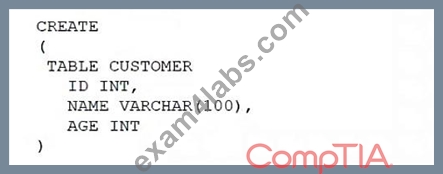
- B.
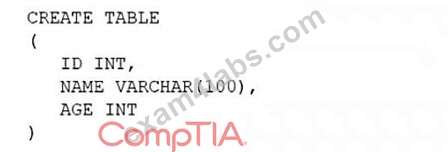
- C.
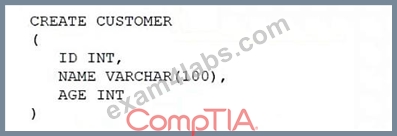
- D.
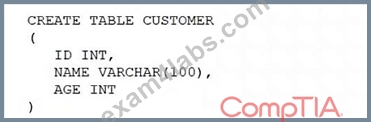
Answer: C
Explanation:
The SQL syntax that the administrator should use to create an object is option B. This syntax uses the CREATE TABLE statement to define a new table named customer with four columns: customer_id, name, email, and phone. Each column has a data type and a constraint, such as NOT NULL or PRIMARY KEY. The other options either have syntax errors, use incorrect keywords, or do not specify the table name or columns correctly. Reference: CompTIA DataSys+ Course Outline, Domain 1.0 Database Fundamentals, Objective 1.1 Given a scenario, identify and apply database structure types.
NEW QUESTION # 62
Which of the following database instances are created by default when SQL Server is installed? (Choose two.)
- A. View
- B. Model
- C. Log
- D. Index
- E. Master
- F. Root
Answer: B,E
Explanation:
The two database instances that are created by default when SQL Server is installed are master and model. Master is a system database that contains the information and settings of the SQL Server instance, such as the configuration, logins, endpoints, databases, etc. Master is essential for the operation and management of the SQL Server instance, and it should be backed up regularly. Model is a system database that serves as a template for creating new user databases. Model contains the default settings and objects, such as tables, views, procedures, etc., that will be inherited by the new user databases. Model can be modified to customize the new user databases according to specific needs or preferences. The other options are either not database instances or not created by default when SQL Server is installed. For example, root is not a database instance, but a term that refers to the highest level of access or privilege in a system; log is not a database instance, but a file that records the changes made by transactions on a database; view is not a database instance, but an object that represents a subset or a combination of data from one or more tables; index is not a database instance, but a data structure that stores the values of one or more columns of a table in a sorted order. Reference: CompTIA DataSys+ Course Outline, Domain 2.0 Database Deployment, Objective 2.3 Given a scenario, update database systems.
NEW QUESTION # 63
Which of the following are the best resources for monitoring potential server issues? (Choose two.)
- A. User connections
- B. Index usage
- C. Firewall usage
- D. CPU usage
- E. Query execution
- F. Memory usage
Answer: D,F
Explanation:
The two resources that are best for monitoring potential server issues are CPU usage and memory usage. CPU usage is the percentage of time that the processor (CPU) of the server is busy executing instructions or processes. CPU usage indicates how much workload the server can handle and how fast it can process requests. High CPU usage may affect the performance or availability of the server and cause delays or errors. Memory usage is the amount of physical memory (RAM) or virtual memory (swap space) that the server uses to store data or run applications. Memory usage indicates how much space the server has to store temporary or intermediate data or results. High memory usage may affect the performance or availability of the server and cause swapping or paging. The other options are either not relevant or not direct indicators of server health. For example, user connections are the number of users who are connected to a database server at any given time; firewall usage is the amount of data that passes through a firewall device or software; index usage is the frequency or efficiency of using indexes on tables to speed up queries; query execution is the process of running SQL statements on a database server. Reference: CompTIA DataSys+ Course Outline, Domain 3.0 Database Management and Maintenance, Objective 3.2 Given a scenario, monitor database performance.
NEW QUESTION # 64
Which of the following NFs is considered the most preferable for relational database design?
- A. 2NF
- B. 1 NF
- C. 4 NF
- D. 3 NF
Answer: D
Explanation:
The NF (normal form) that is considered the most preferable for relational database design is 3 NF. 3 NF, or Third Normal Form, is a level of normalization that organizes data into tables and columns to reduce redundancy and improve consistency. Normalization is a process that applies a set of rules or criteria to eliminate or minimize the anomalies or problems that may arise from inserting, updating, or deleting data in a database. 3 NF is achieved when a table satisfies the following conditions: - It is in 2 NF (Second Normal Form), which means that every non-key column depends on the whole primary key and not on any subset of it - It has no transitive dependencies, which means that every non-key column depends directly on the primary key and not on any other non-key column 3 NF is considered the most preferable for relational database design because it ensures that each table has only one purpose or theme and that each column has only one value or meaning. This helps avoid data duplication, inconsistency, and update anomalies. The other options are either lower or higher levels of normalization that are either less preferable or less practical for relational database design. For example, 1 NF (First Normal Form) is the lowest level of normalization that requires each column to have atomic values and each row to have a unique identifier; 4 NF (Fourth Normal Form) is a higher level of normalization that requires each table to have no multi-valued dependencies, which means that there are no columns that can have more than one value for the same primary key value; 2 NF (Second Normal Form) is an intermediate level of normalization that requires each non-key column to depend on the whole primary key and not on any subset of it. Reference: CompTIA DataSys+ Course Outline, Domain 1.0 Database Fundamentals, Objective 1.2 Given a scenario, execute database tasks using scripting and programming languages.
NEW QUESTION # 65
A database administrator needs a tool to document and explain the relationships between data in an organization's database. Which of the following is the best tool to accomplish this task?
- A. Text editor
- B. Word processor
- C. SQL query
- D. UML editor
Answer: D
Explanation:
The best tool for the database administrator to document and explain the relationships between data in an organization's database is a UML editor. A UML editor is a software application that allows users to create, edit, and visualize diagrams using the Unified Modeling Language (UML). UML is a standard language for modeling software systems and their components, such as classes, objects, relationships, behaviors, etc. UML can also be used to document and explain the relationships between data in an organization's database by creating entity relationship diagrams (ERDs), which are graphical representations of the entities (tables), attributes (columns), and relationships (constraints) in a database. A UML editor can help the administrator to document and explain the relationships between data by providing features such as drag-and-drop, templates, symbols, validation, etc. The other options are either not suitable or not optimal for this task. For example, a text editor is a software application that allows users to create and edit plain text files; a word processor is a software application that allows users to create and edit text documents; an SQL query is a statement that performs an operation on a database using Structured Query Language (SQL). Reference: CompTIA DataSys+ Course Outline, Domain 2.0 Database Deployment, Objective 2.2 Given a scenario, create database objects using scripting and programming languages.
NEW QUESTION # 66
......
CompTIA DS0-001 Dumps PDF Are going to be The Best Score: https://actual4test.exam4labs.com/DS0-001-practice-torrent.html