

[2024] CTAL-TM-001 All-in-One Exam Guide Practice To your CTAL-TM-001 Exam!
Preparations of CTAL-TM-001 Exam 2024 ISQI Certifications Unlimited 67 Questions
How to study the CTAL-TM Exam
There are two main types of resources for preparation of CTAL-TM certification exams first there are the study guides and books that are detailed and suitable for building knowledge from ground up then there are video tutorials and lectures that can somehow ease the pain of through study and are comparatively less boring for some candidates yet these demand time and concentration from the learner. Smart Candidates who want to build a solid foundation in all exam topics and related technologies usually combine video lectures with study guides to reap the benefits of both but there is one crucial preparation tool as often overlooked by most candidates the practice exams. Practice exams are built to make students comfortable with the real exam environment. Statistics have shown that most students fail not due to that preparation but due to exam anxiety the fear of the unknown. Exam4Labs expert team recommends you to prepare some notes on these topics along with it don't forget to practice CTAL-TM exam dumps which had been written by our expert team, Both these will help you a lot to clear this exam with good marks.
NEW QUESTION # 34
You are the Test Manager on a new project. The schedule is aggressive and will require the team to work at peak efficiency. The requirements are not well defined yet, but it is clear that the project will be using new technologies. To help the developers meet the development schedule, an offshore group will be added to the development team.
At this time there is not enough budget to add more testing resources. The project stakeholders are very concerned about the quality of the delivered product and will be watching the project closely, particularly during the testing cycles. The exit criteria from the system test level require no open high priority/severity defects, 100% pass rate for all test cases covering risks that are classified as "high" or "very high", 95% pass rate for all "medium" risks and 75% pass rate for all "low" and "very low" risks.
Given this information, which of the activities of the standard test process are the most critical for the Test Manager to perform? [3]
- A. Test monitoring and control
- B. Test execution
- C. Project management, particularly regarding scheduling and budgeting
- D. Requirements reviews
Answer: A
Explanation:
The most critical activity of the standard test process for the Test Manager to perform in this scenario is test monitoring and control. This is because test monitoring and control involves measuring and evaluating the test progress, quality, and risks, and taking corrective actions when necessary. Given the aggressive schedule, the unclear requirements, the new technologies, the offshore development team, the limited testing resources, and the high stakeholder expectations, the Test Manager needs to closely monitor and control the testing activities to ensure that the test objectives and exit criteria are met, and that any deviations or issues are identified and resolved in a timely manner. Test Monitoring and Control - ISTQB not-for-profit association References: Certified Tester Advanced Level Test Manager (CTAL-TM) - ISTQB not-for-profit association, ISTQB Test Manager Certification - ISTQB Exams Worldwide - ISTQB Official Registration, Test Monitoring and Control - ISTQB not-for-profit association
NEW QUESTION # 35
Given is the following defect removal chart reported at the end of system testing - showing total defects detected and closed defects (fixed and successfully retested). A number of open defects are classified as critical. All tests have been executed.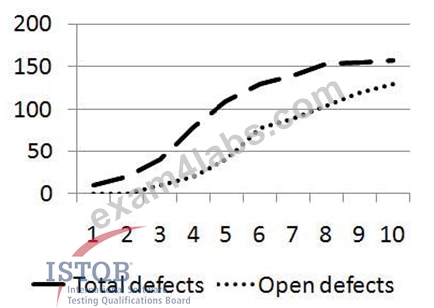
Based on the chart above, what is the most appropriate next test phase? 1 credit
- A. Another system test cycle to verify defect resolution
- B. Requirements testing as part of testing regulatory compliance
- C. Acceptance testing to verify the business process
- D. Acceptance testing to verify operational requirements
Answer: A
NEW QUESTION # 36
Which of the following is NOT a typical key challenge for testing in a RAD based development approach? 1 credit
- A. Project management and control
- B. No complete requirements specification
- C. Re-usable test scripts for (automated) regression testing
- D. Time-boxing
Answer: A
Explanation:
Explanation/Reference:
Explanation:
NEW QUESTION # 37
Your last project was released three months ago and used a risk-based approach. In production, a number of serious failures in low risk areas have occurred.
What is the most important lesson to be learned from this information? [2]
- A. The "lessons learned" session should have been conducted prior to deployment.
- B. Future projects should test the lower risk areas first.
- C. A broader cross-functional team should contribute to the risk analysis.
- D. The project manager should have set stakeholder expectations for serious failures.
Answer: C
Explanation:
The most important lesson to be learned from this information is that a broader cross-functional team should contribute to the risk analysis. This is because the risk analysis is the process of identifying, assessing, and prioritizing the risks that may affect the quality of the system, and allocating testing resources accordingly. A broader cross-functional team can provide different perspectives, expertise, and experience to the risk analysis, and help to identify and evaluate the risks more accurately and comprehensively. This can reduce the likelihood of overlooking or underestimating some risks, and improve the effectiveness and efficiency of the risk-based testing approach. Risk Analysis - ISTQB not-for-profit association References: Certified Tester Advanced Level Test Manager (CTAL-TM) - ISTQB not-for-profit association, ISTQB Test Manager Certification - ISTQB Exams Worldwide - ISTQB Official Registration, Risk Analysis - ISTQB not-for-profit association
NEW QUESTION # 38
Which technique will assist you in determining targeted improvement areas to reduce the number of defects?
[1]
- A. Pareto analysis
- B. Cost of quality analysis
- C. Test coverage assessment
- D. Defect triage
Answer: A
Explanation:
The technique that will assist you in determining targeted improvement areas to reduce the number of defects is Pareto analysis. This is because Pareto analysis is a method of identifying and prioritizing the most significant causes of defects, based on the principle that 80% of the problems are caused by 20% of the causes.
By applying Pareto analysis, you can focus on the improvement areas that will have the most impact on reducing the number of defects. Pareto Analysis - ISTQB not-for-profit association References: Certified Tester Advanced Level Test Manager (CTAL-TM) - ISTQB not-for-profit association, ISTQBTest Manager Certification - ISTQB Exams Worldwide - ISTQB Official Registration, Pareto Analysis - ISTQB not-for-profit association
NEW QUESTION # 39
Which of the following are primary activities in conducting product risk analysis? [1]
- A. Risk identification, risk assessment
- B. Risk management, risk assessment
- C. Risk identification, risk testing
- D. Risk testing, risk management
Answer: A
Explanation:
Product risk analysis is the process of identifying and assessing the product risks that may affect the quality or functionality of the software under test1. Product risk analysis involves two primary activities: risk identification and risk assessment. Risk identification is the activity of finding, naming, and describing the risks that might affect the software under test2. Risk assessment is the activity of estimating the impact and probability of occurrence (likelihood) of the identified risks, and prioritizing them based on these factors3.
Therefore, option B is the correct answer. Option A is incorrect because risk testing and risk management are not primary activities of product risk analysis, but rather activities that follow or use the results of product risk analysis. Risk testing is the activity of designing, implementing, and executing tests based on the product risk levels to reduce the level of product risks and inform stakeholders of their status4. Risk management is the activity of planning, monitoring, and controlling the risks and the risk mitigation actions in the software project5. Option C is incorrect because risk identification and risk testing are not primary activities of product risk analysis, but rather activities that are part of product risk analysis and risk-based testing respectively. Option D is incorrect because risk management and risk assessment are not primary activities of product risk analysis, but rather activities that are part of risk management and product risk analysis respectively. References: 1: ISTQB Glossary, Product Risk Analysis 2: ISTQB Glossary, Risk Identification 3:
ISTQB Glossary, Risk Assessment 4: ISTQB Glossary, Risk-Based Testing 5: ISTQB Glossary, Risk Management : Product Risk Analysis (PRA) | TMap : Risk-Based Testing | ISTQB Glossary : Risk Analysis | ISTQB Glossary
NEW QUESTION # 40
Which of the following product risks would be most effectively addressed just by static testing? 3 credits
- A. In the delivered application, one of the countries, as specified in the requirements, has not been correctly implemented.
- B. The test cases do not cover the key requirements.
- C. The successful bidder may not deliver all the required functionality on time.
- D. The application takes too long to process a request for additional cover.
Answer: B
NEW QUESTION # 41
Which one of the following estimation approaches is appropriate at this stage of the project? 2 credits
- A. Create an estimate based on a percentage of the development effort
- B. Create an estimate based on the credentials of the successful bidder
- C. Create an estimate based on the function point analysis technique and test point analysis
- D. Create an estimate based on the complexity of the code
Answer: C
NEW QUESTION # 42
Which aspect in the test estimate is the main risk in this project? 1 credit
- A. Availability of end-users
- B. The costs of hardware and tools
- C. Quality of the specification
- D. Unknown input quality due to third party development
Answer: D
Explanation:
Explanation/Reference:
Explanation:
NEW QUESTION # 43
Comparing TMMi and TPI, which is not a valid reason for choosing either TPI or TMMi? 2 credits
- A. TPI is much more a bottom-up model that is suitable for addressing test topics for a specific (test) project.
- B. TMMi can only be used with the traditional V model,whereas TPI can be used with all types of software life cycles.
- C. If the organization is already applying CMMI, TMMi may be preferred since it has the same structure and uses the same terminology. TMMi addresses management commitment very strongly and is therefore more suitable to support a top-down improvement process.
- D. If the scope of test performance improvement covers all test levels, TMMi is preferred since TPI focusses mainly on black-box testing.
Answer: B
Explanation:
Explanation/Reference:
Explanation:
NEW QUESTION # 44
Continuing with the Scenario described in the previous question, which of the following topics would you need to address in detail in the master test plan? 3 credits
- A. An approach to regression testing
- B. A logical collection of test cases
- C. A list of boundary values for "advance amount"
- D. A description of dependencies between test cases
Answer: A
Explanation:
Explanation/Reference:
Explanation:
NEW QUESTION # 45
When scheduling performance testing, which of the following approaches would be most advisable? [1]
- A. Starting the performance testing during unit and integration testing
- B. Deferring the start of performance testing until all functional defects have been resolved
- C. Requiring all performance tests to pass before starting functional testing
- D. Leveraging end users to do unit-level performance testing and automated tools for system-level performance testing
Answer: A
Explanation:
Performance testing is the process of determining the speed, responsiveness, and stability of a system under a given workload1. Performance testing should be started as early aspossible in the software development lifecycle, preferably during unit and integration testing, to identify and resolve performance issues before they become costly or risky2. Starting performance testing early can also help to validate the performance requirements, design, and architecture of the system, as well as to optimize the performance testing strategy and scope3. Therefore, option A is the correct answer. Option B is incorrect because deferring the start of performance testing until all functional defects have been resolved can delay the detection and resolution of performance issues, increase the cost and effort of performance testing, and reduce the confidence and quality of the system4. Option C is incorrect because leveraging end users to do unit-level performance testing and automated tools for system-level performance testing can introduce inconsistency, bias, and inefficiency in the performance testing process, as well as compromise the reliability and validity of the performance test results. Option D is incorrect because requiring all performance tests to pass before starting functional testing can create unrealistic or unnecessary expectations, as well as hinder the progress and feedback of the functional testing activities. References: 1: ISTQB Glossary, Performance Testing 2: ISTQB Certified Tester
- Performance Testing (CT-PT)3 3: ISTQB Performance Testing - TesterYou4 4: Performance Testing - ISTQB not-for-profit association : ISTQB - PERFORMANCE TESTING : Performance Testing - ISTQB not-for-profit association
NEW QUESTION # 46
Which of the following is a benefit of independent testing? 1 credit
- A. Independent testers find different defects and are unbiased.
- B. Testing is isolated from development.
- C. Developers do not have to take as much responsibility for quality.
- D. Code cannot be released into production until independent testing is complete.
Answer: A
NEW QUESTION # 47
Which of the following is a valid drawback of independent testing? 1 credit
- A. Independent testers will become a bottleneck and introduce problems in incident management.
- B. Developers loose the sense of responsibility and independent testers may become a bottleneck.
- C. Independent testers need extra education and always cost more.
- D. Developer and independent testing will overlap and waste resources.
Answer: B
Explanation:
Explanation/Reference:
Explanation:
NEW QUESTION # 48
Which one of the following estimation approaches is appropriate at this stage of the project? 2 credits
- A. Create an estimate based on a percentage of the development effort
- B. Create an estimate based on the credentials of the successful bidder
- C. Create an estimate based on the function point analysis technique and test point analysis
- D. Create an estimate based on the complexity of the code
Answer: C
Explanation:
Explanation/Reference:
Explanation:
NEW QUESTION # 49
Your company just won a contract to create a new sales application and has committed to a very aggressive delivery timeline. Due to the quick turnaround your primary stakeholder wants to be heavily involved in the design and is very anxious to see the outcome. Because of this, your company has decided to use a spiral development approach. You have a defined test policy and typically use an analytical approach to testing, however, this approach will not work with the development approach.
What test strategy should be utilized? [3]
- A. Methodical
- B. Reactive
- C. Model-based
- D. Standard-compliant
Answer: B
Explanation:
A reactive test strategy is a test strategy that uses the actual behavior and results of the software under test to design and execute tests, without prior knowledge or documentation of the software1. A reactive test strategy should be utilized for a project that uses a spiral development approach, which is a type of iterative/incremental approach that adds risk analysis and prototyping activities to each iteration2. A reactive test strategy is suitable for a spiral development approach because it allows for flexibility, adaptability, and creativity in the testing process, as well as for early feedback, risk reduction, and continuous improvement in the software development process3. Therefore, option D is the correct answer. Option A is incorrect because a model-based test strategy is a test strategy that uses models to represent the desired behavior and structure of the software under test, and to derive test cases, test data, test procedures, and test oracles. A model-based test strategy may not work well with a spiral development approach, as it requires the availability and stability of the models, which may not be the case in a spiral development approach that involves frequent changes and refinements of the software under test. Option B is incorrect because a methodical test strategy is a test strategy that uses predefined test methods, techniques, and procedures to design and execute tests, such as equivalence partitioning, boundary value analysis, or decision table testing. A methodical test strategy may not work well with a spiral development approach, as it requires the availability and stability of the test basis, such as the requirements, specifications, or design documents, which may not be the case in a spiral development approach that involves frequent changes and refinements of the software under test. Option C is incorrect because a standard-compliant test strategy is a test strategy that follows a predefined set of standards, guidelines, or regulations to design and execute tests, such as ISO, IEEE, or CMMI. A standard-compliant test strategy may not work well with a spiral development approach, as it requires the compliance and consistency of the testing process, which may not be the case in a spiral development approach that involves frequent changes and refinements of the software under test. References: 1: ISTQB Glossary, Reactive Test Strategy 2:
ISTQB Glossary, Spiral Model 3: ISTQB Advanced Level Test Manager Syllabus, Section 1.1.1 : Spiral Model in Software Development Life Cycle - Software Testing Material : Spiral Model - Tools QA : Strategic Test Management - ISTQB not-for-profit association : ISTQB Glossary, Model-Based Testing : ISTQB Glossary, Methodical Test Strategy : ISTQB Glossary, Standard-Compliant Test Strategy : ISTQB Foundation Level #39 - Test Approach and Strategy - Software Testing Mentor
NEW QUESTION # 50
Since the system is in the medical domain and therefore in the safety critical area, testing needs to be rigorous and evidence is required that the system has been adequately tested. Identify THREE measures that would typically be part of the test approach in this domain and which are not always applicable in other domains! 1 credit
- A. Failure Mode and Effect Analysis (FMEA) sessions
- B. High level of documentation
- C. Test design techniques
- D. Reviews
- E. Non-functional testing
- F. Master test planning
- G. Traceability to requirements
Answer: A,B,G
Explanation:
Explanation/Reference:
Explanation:
NEW QUESTION # 51
You are the Test Manager on a new project. The schedule is aggressive and will require the team to work at peak efficiency. The requirements are not well defined yet, but it is clear that the project will be using new technologies. To help the developers meet the development schedule, an offshore group will be added to the development team.
At this time there is not enough budget to add more testing resources. The project stakeholders are very concerned about the quality of delivered product and will be watching the project closely, particularly during the testing cycles. The exit criteria from the system test level require no open high priority/severity defects, 100% pass rate for all test cases covering risks that are classified as
"high" or "very high", 90% pass rate for all "medium" risks and 50% pass rate for all "low" and "very low" risks.
Given this information, which lifecycle model should you recommend?[3]
- A. V-model
- B. Waterfall
- C. Spiral
- D. Iterative/incremental
Answer: D
Explanation:
An iterative/incremental lifecycle model is a type of software development lifecycle that divides the project into smaller iterations or increments, each delivering a part of the functionality and undergoing its own planning, analysis, design, implementation, and testing phases1. This model is suitable for projects that have aggressive schedules, unclear requirements, new technologies, distributed teams, and high quality expectations, as it allows for early feedback, risk reduction, parallel development, frequent delivery, and continuous improvement2. Therefore, option B is the correct answer. Option A is incorrect because a spiral model is a type of iterative/incremental model that adds risk analysis and prototyping activities to each iteration3. While this model can also handle unclear requirements, new technologies, and high quality expectations, it may not be the best choice for projects that have aggressive schedules and distributed teams, as it requires more time and communication for risk assessment and prototyping4. Option C is incorrect because a V-model is a type of sequential model that maps each development phase to a corresponding testing phase in a V-shaped diagram5. This model is suitable for projects that have clear and stable requirements, well-known technologies, co-located teams, and moderate quality expectations, as it allows for early verification, traceability, and defect prevention. However, this model may not be the best choice for projects that have aggressive schedules, unclear requirements, new technologies, distributed teams, and high quality expectations, as it does not allow for early feedback, risk reduction, parallel development, frequent delivery, and continuous improvement. Option D is incorrect because a waterfall model is a type of sequential model that follows a linear sequence of phases from requirements to deployment. This model is suitable for projects that have simple and fixed requirements, well-known technologies, co-located teams, and low quality expectations, as it allows for easy planning, management, and documentation. However, this model may not be the best choice for projects that have aggressive schedules, unclear requirements, new technologies, distributed teams, and high quality expectations, as it does not allow for early feedback, risk reduction, parallel development, frequent delivery, and continuous improvement. References: 1: ISTQB Glossary, Iterative/incremental lifecycle model 2: ISTQB Advanced Level Test Manager Syllabus, Section 1.2.1 3:
ISTQB Glossary, Spiral model 4: ISTQB Advanced Level Test Manager Syllabus, Section 1.2.1 5: ISTQB Glossary, V-model : ISTQB Advanced Level Test Manager Syllabus, Section 1.2.1 : ISTQB Advanced Level Test Manager Syllabus, Section 1.2.1 : ISTQB Glossary, Waterfall model : ISTQB Advanced Level Test Manager Syllabus, Section 1.2.1 : ISTQB Advanced Level Test Manager Syllabus, Section 1.2.1
NEW QUESTION # 52
Comparing TMMi and TPI, which is not a valid reason for choosing either TPI or TMMi? 2 credits
- A. TPI is much more a bottom-up model that is suitable for addressing test topics for a specific (test) project.
- B. TMMi can only be used with the traditional V model,whereas TPI can be used with all types of software life cycles.
- C. If the organization is already applying CMMI, TMMi may be preferred since it has the same structure and uses the same terminology. TMMi addresses management commitment very strongly and is therefore more suitable to support a top-down improvement process.
- D. If the scope of test performance improvement covers all test levels, TMMi is preferred since TPI focusses mainly on black-box testing.
Answer: B
NEW QUESTION # 53
Which of the following are valid reasons for adopting a different life cycle (from the V model), for increments after the first year? 2 credits i. We do not have a clear understanding of the requirements from a customer perspective.
ii. We see the risk of delivering requested functionality late as being higher than the risk of delivering a lower quality product.
iii. We do not have a budget for additional regression testing which is needed to ensure that existing functionality is not compromised by future iterations.
iv. The company test strategy does not fit well within the V life cycle model.
- A. (ii) and (iii)
- B. (i) and (ii)
- C. (i) and (iv)
- D. (ii) and (iv)
Answer: B
Explanation:
Explanation/Reference:
Explanation:
Topic 6, Scenario 6, V4 "Independent Test Team"
You have for a while been trying to hire a second test automation specialist for your test team However, you did not have any luck in finding a suitable candidate. So now, you have been asked by IT management of XYZ to forward a proposal with alternative solutions for building an automated regression test suite at system test level over a period of 2 years including needed training and eventual handover to the test team.
NEW QUESTION # 54
Given the following figures for the testing on a project, and assuming the failure rate for initial tests remains constant and that all retests pass, what number of tests remain to be run? 3 credits
- A. 0
- B. 1
- C. 2
- D. 3
Answer: D
Explanation:
Explanation/Reference:
Explanation:
NEW QUESTION # 55
......
CTAL-TM Certification Path
6 months of experience in Software development/software testing. Successful completion of the ISTQB Certified Tester Foundation level and a minimum of three years testing experience is recommended. The Intermediate Certificate may also be helpful but is not required.
Focus on CTAL-TM-001 All-in-One Exam Guide For Quick Preparation: https://actual4test.exam4labs.com/CTAL-TM-001-practice-torrent.html