

100% Updated NBRC RPFT Enterprise PDF Dumps
Use Valid Exam RPFT by Exam4Labs Books For Free Website
NBRC RPFT exam is an important certification for Advanced Pulmonary Function Technologists. RPFT exam is designed to test the knowledge and skills of individuals who are working in the field of pulmonary function testing. RPFT exam is created and administered by the National Board for Respiratory Care (NBRC), which is a non-profit organization that is committed to ensuring the highest standards of respiratory care.
NEW QUESTION # 15
A 9-year-old girl had an FVC of 2.35 L1 year ago. She was 122 cm (4 ft) tall and weighed 29.5 kg (65 lb).
Her current height is 127 cm (4 ft 2 in), and her weight is 34 kg (75 lb). The current FVC measurement is 2.20
L. The quality of both tests met ATS/ERS goals. A pulmonary function technologist should conclude the change is
- A. Not significant since it is less than a 15% decrease.
- B. Not significant since it is within normal test variability.
- C. Significant since a decline is not expected.
- D. Significant since her weight has changed.
Answer: C
NEW QUESTION # 16
During calibration of a spirometer, injection of air with a 3-liter syringe results in the following:
Using another 3-liter syringe, air is again injected with the following results:
A pulmonary function technologist should conclude that the
- A. Spirometer has intermittent failure
- B. Spirometer is alinear
- C. Calibration should be repeated
- D. First syringe is not set properly
Answer: D
NEW QUESTION # 17
A 54-year-old male with a normal ECG at rest develops dyspnea during an exercise (stress) test, and the following ECG pattern is noted at 25 watts: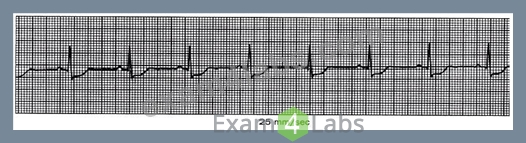
25 mm/sec A pulmonary function technologist should
- A. Continue the test until the subject reaches target heart rate.
- B. Stop the test immediately; there is evidence of heart block.
- C. Stop the test immediately; there is evidence of ischemia.
- D. Continue the test and obtain an arterial blood sample.
Answer: B
NEW QUESTION # 18
While setting up an exercise laboratory in a city with an altitude of 8,600 ft (2,775 m), a pulmonary function technologist notices the fuel cell O2 analyzer is displaying 15.2%. Which of the following is the best explanation for this finding?
- A. The fuel cell needs to be changed.
- B. The analyzer is responding to P1O2.
- C. This exercise system will not work at high altitude.
- D. F1O2 decreases with increasing altitude.
Answer: B
NEW QUESTION # 19
Airways resistance and specific conductance tests are requested for a 7-year-old child with asthma. Which of the following techniques is preferred?
- A. Interrupter
- B. Panting with body plethysmography
- C. Quiet breathing with body plethysmography
- D. Oscillation
Answer: B
NEW QUESTION # 20
To facilitate measurement of arterial oxygen content during an exercise (stress) test, a pulmonary function technologist should recommend
- A. An arterial puncture at anaerobic threshold
- B. End-tidal monitoring
- C. Radial artery catheterization
- D. Pulse oximetry
Answer: D
NEW QUESTION # 21
When performing exercise testing on a biologic control, the measurements obtained should be compared with
- A. At least two other biologic controls being tested.
- B. The patient population that will be tested.
- C. Predicted values used for the biologic control's height and weight
- D. Previous tests performed on the biologic control.
Answer: D
NEW QUESTION # 22
A patient's vital capacity is slightly reduced, the FEWFVC is normal, and the uncorrected DLco is increased.
Which of the following is the most likely diagnosis?
- A. diffuse pulmonary fibrosis
- B. kyphoscoliosis
- C. polycythemia vera
- D. diaphragmatic hemiparesis
Answer: C
NEW QUESTION # 23
After finishing the exercise portion of a test for exercise-induced bronchospasm, a patient
complains of difficulty "catching her breath." A pulmonary function technologist should
- A. Have the patient perform an FVC maneuver.
- B. Instruct the patient to breathe normally.
- C. Administer oxygen at 2 L/min.
- D. Give the patient a bronchodilator.
Answer: D
NEW QUESTION # 24
A pulmonary function technologist is performing quality control on a nebulizer used in the 5-breath dosimeter bronchial challenge. The target output of the device is 0.09 mL, plus or minus 10%. After 10 actuations, the nebulizer output was 75 µL with a 2.0 mL initial saline dose in the nebulizer. The technologist should
- A. Accept the results and begin using the device.
- B. Open the vent before starting the bronchial challenge.
- C. Clean and reevaluate this nebulizer.
- D. Add an exhalation filter and proceed with testing patients.
Answer: A
NEW QUESTION # 25
A patient is performing a flow-volume loop. A pulmonary function technologist observes equal decreases in expiratory and inspiratory flows resulting in plateaus. Patient effort is satisfactory, and he follows instructions well. The technologist should expect the patient to have a
- A. Small airways obstruction
- B. Fixed large airways obstruction.
- C. Variable large airways obstruction
- D. Restrictive disorder
Answer: D
NEW QUESTION # 26
A subject has the following values reported: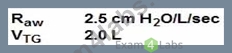
WhatistheSGAW?
- A. 0.20
- B. 1.25
- C. 0.40
- D. 0.80
Answer: B
NEW QUESTION # 27
A pulmonary function technologist is performing an exercise study on a patient with sarcoidosis. Which of the following end-tidalCO2values should the technologist expect at rest, if the test is performed appropriately?
- A. 2-3%
- B. 0-1.5%
- C. 4-5%
- D. 7-10%
Answer: C
NEW QUESTION # 28
A patient who is about to begin pulmonary function testing is visibly upset and complains to a pulmonary function technologist that she felt a receptionist was rude to her. Which of the following should the technologist do?
- A. Give the patient time to calm down and ask the laboratory manager to become involved.
- B. Try to get the patient to calm down by telling her that the receptionist is probably just having a bad day.
- C. Accompany the patient back to the reception area and try to determine who was at fault.
- D. Ignore the complaint because it is not going to affect the testing about to begin.
Answer: A
NEW QUESTION # 29
Successive peak flow measurements made with a peak flowmeter on a subject previously diagnosed as having asthma yield the following results: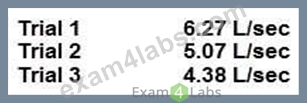
Which of the following is the best explanation for these?
- A. Improper calibration of the peak flowmeter
- B. Increasing airways resistance in the subject
- C. Condensation of moisture in the peak flowmeter
- D. Normal response
Answer: B
Explanation:
Explanation/Reference:
NEW QUESTION # 30
During the calibration and set-up of the metabolic stress testing system for a patient breathing supplemental oxygen, which of the following gas concentrations will ensure accurate calibration of the system?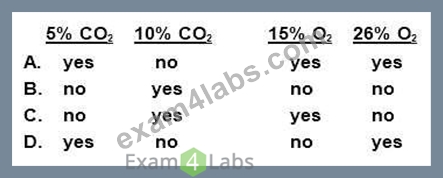
- A. Option D
- B. Option B
- C. Option A
- D. Option C
Answer: A
NEW QUESTION # 31
Using a peak flowmeter, a pulmonary function technologist obtains the following: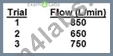
The technologist should
- A. Report the patient's peak flow as 750 L/min.
- B. Perform at least one more peak flow trial.
- C. Report the average of the two best efforts.
- D. Conclude that bronchodilatation has occurred.
Answer: B
NEW QUESTION # 32
The following arterial blood gas results are obtained during the final workload of a cardiopulmonary exercise test: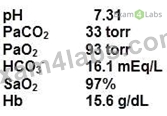
Which of the following best explains these results?
- A. IV solution has contaminated the blood sample.
- B. The test indicates a right-to-left shunt.
- C. There is air contamination since the PaCO2is so low.
- D. Blood gas results are normal for someone at end-exercise.
Answer: D
NEW QUESTION # 33
......
NBRC RPFT (Registry Examination for Advanced Pulmonary Function Technologists) Certification Exam is a comprehensive exam designed for individuals who have advanced knowledge and skills in pulmonary function testing. RPFT exam is administered by the National Board for Respiratory Care (NBRC), which is a non-profit organization that oversees the certification and credentialing of respiratory therapists and pulmonary function technologists.
NBRC RPFT Official Cert Guide PDF: https://actual4test.exam4labs.com/RPFT-practice-torrent.html